
Most visitors walk up to a ticket machine at Barajas or at Sol, buy a single ticket, and then buy another one six more times over the next three days. Some buy a tourist pass for a city they were going to walk across anyway.
Neither is a disaster — Madrid is cheap to move around by European standards, and the worst case costs you a few euros.
But the fare system has a logic, and once you see it the decision takes about thirty seconds. There is one thing you have to buy before you can buy a ticket. There is a supplement that catches almost everyone arriving from the airport.
And since June there is a way to skip the machine entirely that most guides have not caught up with yet.
Here is what Madrid metro tickets cost, which one is right for the days you are here, and the two rules that catch people out. Everything below was checked against the CRTM, the regional transport authority, on 17 August 2026.
The short answer
If you want to stop reading here, this is the whole article in five lines.
- Two or three days in the centre, two people: the 10-journey ticket, €7.30, shared between you.
- A week, moving constantly, museums every day: the Tourist Travel Pass, Zone A, €43.20.
- A ride or two a day, and you hate queuing: tap your bank card straight on the barrier, €1.50 a ride, no card to buy.
- Arriving from the airport: add €3 per person, per journey, whatever you choose. Tapping in at the terminal comes to €4.50.
- Staying in the old centre for a weekend: you may not need any of this. Sol to La Latina is a twelve-minute walk.
That last line is not modesty. The historic centre is smaller than people expect, and the Metro is often the slower option for short hops once you count the stairs.
Madrid metro tickets: what a ride actually costs
There are two ways to pay, and they do not cost the same.
The traditional way is to buy a ticket at a machine and load it onto a card. Inside Zone A that is €1.50 for up to five stations, ten cents more for each station from the sixth to the ninth, and €2.00 from ten onwards. A short hop and a cross-city run are not the same price.
The new way, since 1 June 2026, is to tap a bank card, phone or watch on the barrier: €1.50 flat, however far you go, with no machine and no card to buy.
Two rules come with it. Tap in and tap out, at the exit gate as well as the entry one, and at any gate in between.
And use the same card or device throughout — tap in with your phone and out with the plastic and the system reads two people, and charges twice.
Tapping also only buys single rides: for the ten-journey ticket, a monthly pass or the Tourist Travel Pass you still need a machine.
- Tap your bank card at the barrier: €1.50, any distance inside Zone A. Same card in and out.
- Ticket bought at the machine: €1.50 up to 5 stations · +€0.10 per station from the 6th to the 9th · €2.00 from 10 stations.
- 10-journey ticket (Metrobús): €7.30 — that is 73 cents a ride. Machine only.
- Airport supplement: €3.00 on top, each way, whichever way you pay.
- Metro hours: 06:00 to 01:30, every day of the year.
The ten-journey ticket is the one most visitors should be looking at and almost none find. €7.30 for ten rides, no expiry, valid on the Metro inside Zone A, on the blue city buses and on light rail line 1.
Two or three of you can share one, as long as you board and leave together — you tap it once per person.
That price is a 40% discount the regional government has extended until 31 December 2026. If you are reading this later, check before you assume.
The €3 that catches everyone at the airport
Arriving on the Metro from Barajas costs €3 more than you think. The supplement applies at both airport stations, in both directions, per journey rather than per day.
It applies however you pay. At the machine, €3 goes on top of your ticket. At the barrier, the barrier adds it, so a ride into town is €4.50 rather than €1.50. It is not a penalty for paying by card — the charge belongs to the station. Go back the same way and you pay it again.
Two things get you out of it: the Tourist Travel Pass includes it, and Cercanías does not charge it at all — which is why the train is the cheapest way in from Terminal 4.
The card you need before you can buy a ticket
This is the step nobody warns you about. In Madrid, a paper ticket does not exist. Every ticket you buy at a machine has to sit on a plastic card, and the card is sold separately.
It is called the Tarjeta Multi, it costs €2.50, and you buy it from the same machine, in the same transaction. It lasts ten years, it is not tied to your name, and — this is the useful part — it is not personal.
One card can carry a 10-journey ticket that two or three of you use together.
So the real cost of your first Metro ride, buying the traditional way, is €2.50 for the card plus the ticket on top.
Which is exactly why the 10-journey option makes sense the moment there is more than one of you, and why tapping a bank card makes sense if there is only one of you and you are here for two days.
You do not need the Multi at all if you pay by contactless at the barrier. You do not need it either if you buy the Tourist Travel Pass, because that one comes with its card included in the price.
The Tourist Travel Pass: when it pays off, and when it doesn’t
The Abono Turístico, sold in English as the Tourist Travel Pass, is unlimited travel for a fixed number of days. It comes in two versions, and the difference between them is geography, not quality.
- 1 day: €10.30
- 2 days: €17.50
- 3 days: €23.10
- 4 days: €27.80
- 5 days: €33.40
- 7 days: €43.20
- Children under 11: 50% off
- 1 day: €15.40
- 2 days: €26.20
- 3 days: €35.00
- 4 days: €43.20
- 5 days: €50.40
- 7 days: €62.80
- Children under 11: 50% off
Four things before you buy one. The card is included — €10.30 is the whole price, not €10.30 plus €2.50. It starts when you first use it, not when you buy it, so you can pick one up on arrival and begin the next morning.
A “day” is a calendar day, not twenty-four hours — validate at four in the afternoon and you have burnt a day by midnight, the one exception being night services, where it holds until 05:00.
It covers the airport supplement, in both zones, which is where most of its value sits on a short stay.
Now the arithmetic the tourist offices skip. A 3-day Zone A pass is €23.10; three days on a ten-journey ticket is €7.30, and you would need thirty-odd rides before the pass wins on fares alone. Two airport supplements at €3 narrow the gap without closing it.
The pass wins when you are travelling alone, staying at least five days, and using the Metro four or five times a day. It loses, comfortably, for a couple spending a long weekend in the centre.
It is not a bad product; it is just sold to a lot of people who are not its customer.
Zones: what “Zone A” actually covers
Madrid has eight fare zones — A, B1, B2, B3, C1 and C2 inside the region, plus E1 and E2 over the border in Castilla-La Mancha. You will almost certainly only ever be in one of them.
Zone A is the city of Madrid, near enough. Every Metro station you are likely to use, every blue city bus except the yellow Airport Express, the commuter trains between Zone A stations, and light rail line 1.
Zone T is everything, out to the far edge of the network: the whole Metro, the interurban coaches, the entire Cercanías network and the remaining light rail lines.
Zone T only makes sense if you are leaving the city, and it does cover some good days out — Alcalá de Henares, El Escorial, Aranjuez, Chinchón.
It does not cover Segovia or Ávila. Those are in a different region and outside the system entirely.
Toledo is the awkward one, and most guides get it wrong in both directions. The zone does reach across into Castilla-La Mancha, and the regional coach from Plaza Elíptica is inside the system.
But the Avant — the fast train almost everyone actually takes, thirty-odd minutes from Atocha — is not covered by any transport pass. If Toledo is on your list, price that trip on its own.
Buses, Cercanías and the two free lines
The blue city buses (EMT) cost the same €1.50, and you can buy on board — cash, with change up to €5, or card or phone. What you cannot buy on board is the ten-journey ticket; that comes from machines and tobacconists.
Changing buses, ask for a TransBus at €1.80: one transfer within sixty minutes.
Two lines are free. The 001 runs Atocha to Moncloa, 07:00 to 23:30, every seven or eight minutes; the 002 runs Argüelles to Puerta de Toledo, 08:00 to 21:00. No ticket, no tap.
They have been running for six years and I have never seen them in a guidebook.
At night, 29 búho (“owl”) lines take over from midnight to six, all radiating from Cibeles, at the same €1.50.
Cercanías, the commuter rail, matters to a visitor in three situations: getting in from Terminal 4, crossing town between Atocha and Chamartín, and heading out for the day. It prices by zone, and almost every trip a visitor makes falls in the cheapest band.
- One or two zones — which covers the whole city: €1.70.
- Beyond that: three zones €1.85 · four €2.60 · five €3.40 · six €4.05 · seven €5.50.
- No airport supplement. The €3 is a Metro charge only.
- Paying by contactless: you must tap in and tap out. Miss the second tap and you are charged the maximum fare for every zone on the network.
- 40% off from your fifth journey in the same calendar month, on the same card.
- Free with a long-distance train ticket if you are connecting to or from a flight, with at least 2h30 between the two.
The 40% rarely helps a visitor: five journeys in one calendar month is a resident’s pattern. The tap-out penalty is the one to remember — not a rounding up, the longest journey on the network.
Hours, and the last train home
The Metro runs 06:00 to 01:30, every day of the year. Not “roughly”, not “later at weekends” — Madrid is a city that eats at ten and the Metro still shuts at half past one.
This catches people out more than any fare rule. A dinner that starts at 21:30 finishes close to midnight, and a second stop after that puts you on the wrong side of the last train.
Which is what the búhos are for: from Cibeles, all night, €1.50.
If you are holding a Tourist Travel Pass, it stays valid on those night buses until 05:00 — a small detail that means the pass covers the one night you are most likely to need it.
Which is a good moment to sort out your phone. Save the network map before you land: it is the thing you will open twenty times, usually underground and usually without signal.
- Metro de Madrid Oficial: free, in English, published by Metro. Network map, live service status, station detail. Metro only: no buses, no commuter trains.
- Google Maps: for actually planning the journey. It covers the buses and the trains too.
- Why both: the official app’s route planner has a poor reputation. Use it for the map and for knowing whether a line is down; plan the route somewhere else.
Which station for which neighbourhood
The station you want depends on where you’re heading, and no fare table tells you that. That part is what to see and do in Madrid.
Madrid’s neighbourhoods are not signposted underground; you have to know which stop belongs to which. The centre is compact enough that several of these are within ten minutes of each other on foot.
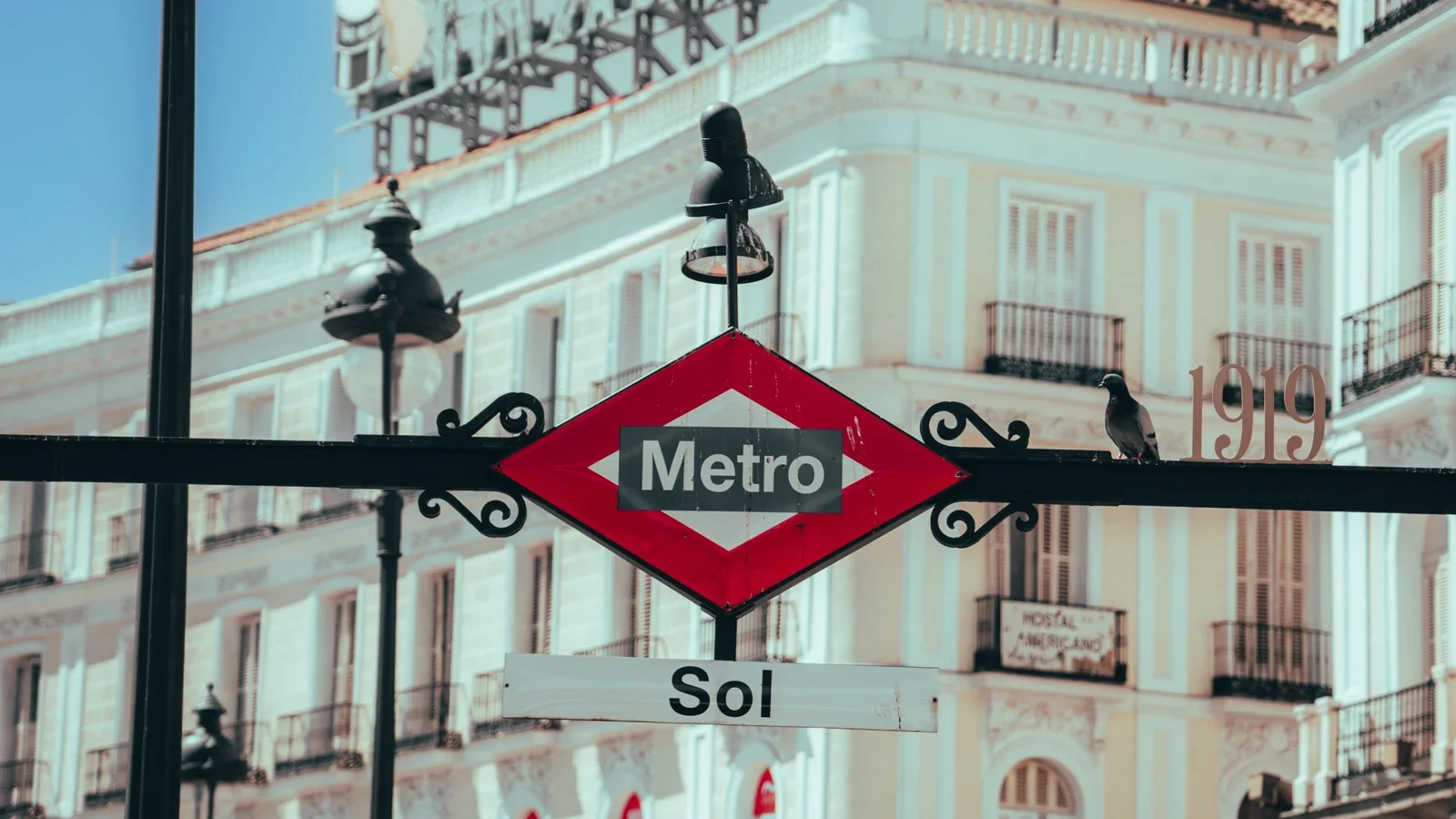
- Sol — lines 1, 2 and 3, plus Cercanías: the dead centre, and the busiest interchange in the city.
- La Latina — line 5: Sunday’s Rastro market and the tapas streets around Cava Baja.
- Gran Vía — lines 1 and 5: theatres, the big shopping street, and the top of Chueca.
- Tribunal (lines 1 and 10) or Noviciado (line 2): for Malasaña. Tribunal for the eastern half, Noviciado for the western.
- Lavapiés — line 3: the most mixed neighbourhood in the centre.
- Serrano — line 4: Salamanca, and the expensive end of the shopping.
- Nuevos Ministerios — lines 6, 8 and 10, plus most Cercanías lines: where line 8 from the airport ends, and where you change for almost anything.
Two notes. Sol is unavoidable and worth avoiding — the busiest station in the city, and at six in the evening it feels like it; Gran Vía or Ópera are often a calmer way into the same streets.
And Nuevos Ministerios is the one to remember: where the airport line ends, and from there almost anywhere without a second change.
How many of these you actually need, staying in the old centre, is fewer than you think. Sol to La Latina is twelve minutes on foot and you see more of the city walking it.
The Metro earns its keep on the longer runs — out to Salamanca, up to Chamberí, back from the airport.
And if you would rather cover that ground with someone who knows which streets are worth the detour, that is more or less what I do for a living — the Hidden Madrid Bike Tour goes where the Metro does not.
Frequently asked questions
What time does the Madrid metro close?
At 01:30, every night, all year. Last trains leave the ends of the lines around then, so if you are far out, start earlier. After that the búho night buses run from Plaza de Cibeles until six, for the same €1.50.
How much is a metro ticket in Madrid?
€1.50 for up to five stations, rising in ten-cent steps to €2.00 for ten or more. Tap a bank card on the barrier instead and it is €1.50 flat, whatever the distance. Ten journeys bought together cost €7.30 — 73 cents a ride.
Do I need a card before I can buy a ticket?
Yes, if you buy at a machine: tickets have to sit on a Tarjeta Multi, €2.50, sold from the same machine. It lasts ten years, is not tied to your name, and a group can share one. You can skip it by tapping a bank card at the barrier, or with the Tourist Travel Pass, which includes its card.
How does the Madrid metro work?
Twelve numbered lines plus a short branch, 06:00 to 01:30. You validate going in, and on some lines — the airport one included — going out too, so keep your card until you are through. Trains every three to five minutes in the centre, and the whole city is one fare zone.
Is the Madrid Tourist Travel Pass worth it?
It depends how many of you there are. Alone, five days or more, several rides a day: yes, and it covers the airport supplement, which is where much of its value sits. A couple on a long weekend in the centre: no — two people sharing a €7.30 ten-journey ticket will not come near €17.50 a day.
Can I pay with a bank card on the Madrid metro?
Yes, since June 2026: tap a contactless card, phone or watch on the barrier and the fare is €1.50 flat, no machine, no Tarjeta Multi. Three catches. Use the same card or device in and out, or the system reads two people and bills you twice. It only buys single rides, not the ten-journey ticket or the tourist pass. And airport journeys still add the €3, so tapping in at Terminal 4 is €4.50. The flat €1.50 is officially temporary, so check before you travel.
Closing
Madrid’s fare system is not complicated once you accept its one strange rule: you buy the card before you buy the ticket. Everything else follows from that.
What is easy to miss is how little of it you may need. The city’s centre was built for walking, at a scale that predates all of this, and its best hours tend to happen between the stations rather than at them.
Buy the ten-journey ticket, keep it in your pocket for the long hauls, and go the rest of the way on foot.