
I have spent twelve years crossing Madrid, and I have watched a lot of people fly home with a bazaar fan and a football shirt that was never official. It does not have to go that way. These are the Madrid souvenirs I would carry home myself: eleven things, each with the shop, the street, the number, the opening hours and the price. Almost all of them cost less than €100. The expensive ones sit in a box of their own, further down, so you can decide.
There is one rule behind the list: it has to be from Madrid, not just from Spain. And at the end, the part no souvenir guide covers — what your country’s customs will let through, what has to go in the hold, and how to claim the VAT back at Barajas.
Everything below was checked against official sites and the city’s own shop records on 25 August 2026.
At a glance
- Entry price: from €2.70 for a box of violet sweets to €65 for a pair of leather gloves. Everything on the list is under €100.
- Where: all of it in the centre and on foot, between Plaza Mayor, Sol and the Paseo del Prado. The one exception is Serrano 54, for the gloves.
- August: Casa Mira closes for the whole month. Capas Seseña closes from the 9th to the 24th.
- What does not fly: ham is banned for travellers entering the United States, the United Kingdom and New Zealand.
What to buy in Madrid: the rule I use
Most of what is sold as a Madrid souvenir comes from somewhere else. Saffron is from La Mancha. Ham is from Guijuelo or Jabugo. The ceramics are from Talavera. There is nothing wrong with any of that — they are good products — but it is worth knowing before you pay for a memory of Madrid.
My test is simple. One: the shop has a name, a street and a number, and in most cases it carries the centenary plaque the city council awards; there are 166 of them on the municipal register. Two: the thing is made here, was designed here, or has been sold in the same shop for more than a century. Three: it has a price on display and it fits in a suitcase.
When the Madrid part is the shop rather than the workshop — that happens with the fans and with the gloves — I say so. I would rather you heard it from me.
1. Espadrilles from Casa Hernanz
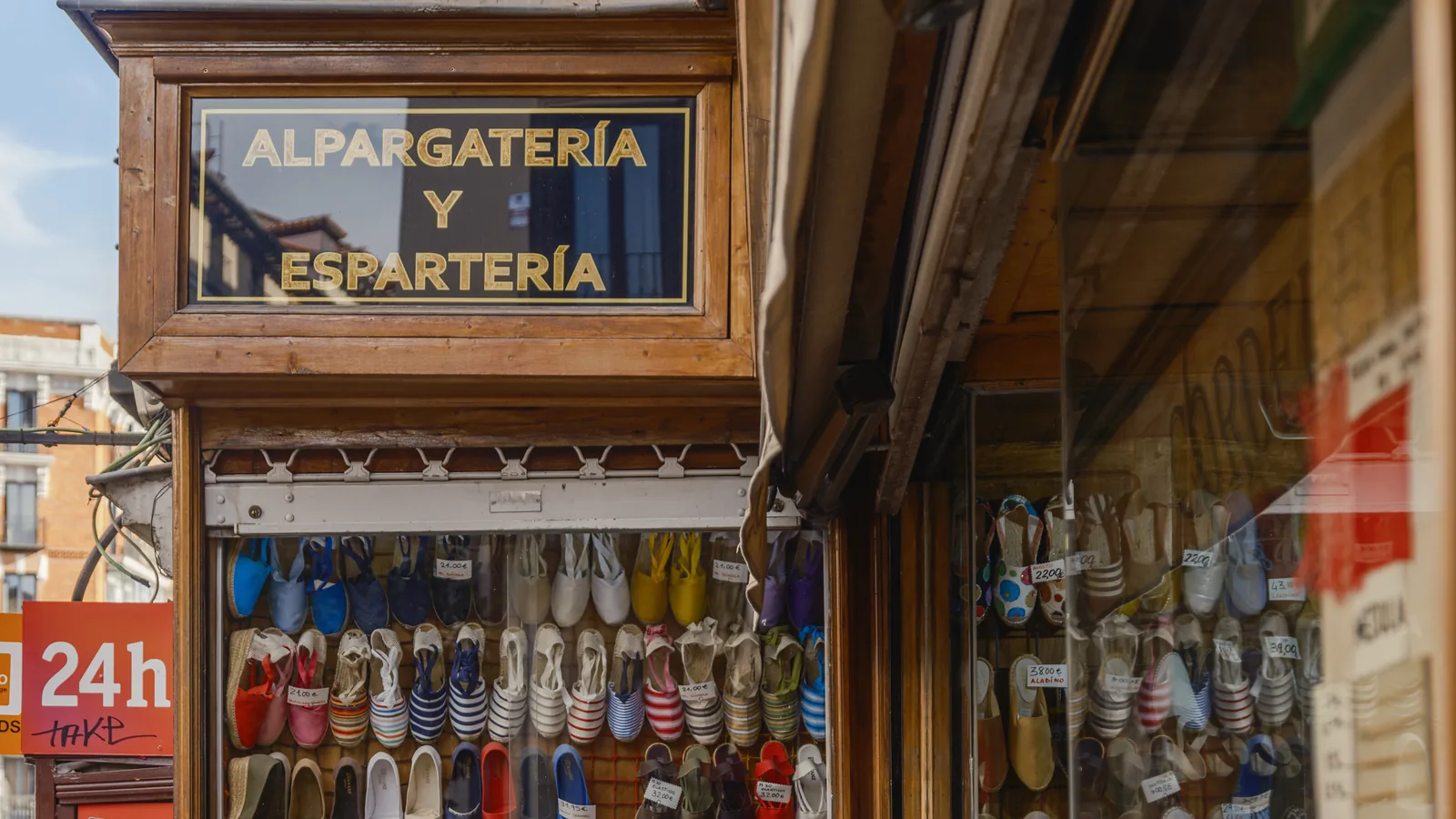
A cotton canvas espadrille with a jute and rubber sole, stitched by hand in Spanish workshops. The shop has been in the same unit on Calle de Toledo since the 1840s, when Toribio Hernanz opened an alpargatería and rope works for the farmhands coming down to Plaza Mayor. The sixth generation runs it now, sells around 100,000 pairs a year, and keeps some thirty colours on the counter.
It is the most useful souvenir in Madrid, because you put it on the next morning. The traditional flat model costs €11.50.
The trap: the bazaar espadrille with a synthetic sole. The real one is jute, cotton and rubber, and you can feel it when you bend it.
Where to buy
- Address: Calle de Toledo 18, a minute below Plaza Mayor.
- Hours: Monday to Friday 9:30–13:30 and 16:30–20:00 · Saturday 10:00–14:00 · closed Sunday.
- Price: flat traditional espadrille €11.50 · herringbone model €19.95 · espadrille keyring €4.
- In your suitcase: no problem at all. They weigh nothing and they do not crease.
2. Violet sweets from La Violeta
The Madrid sweet, and there is no second one: a hard purple drop shaped like a violet and tasting of one. Mariano Gil Temiño opened the shop on Plaza de Canalejas in 1915, and the story that Alfonso XIII bought his violets here for Queen Victoria Eugenia is part of the house’s official history. Three generations on, the box has not changed.
It is the cheapest thing on this list and the one that travels best. A 100 g box costs €2.70. I buy several and hand them out.
The trap: generic violet sweets, from other makers, in any pick-and-mix shop in the centre. They are not bad. They are simply not these.
Where to buy
- Address: Plaza de Canalejas 6, between Sol and the Carrera de San Jerónimo.
- Hours: Monday to Saturday 10:00–20:00 · closed Sunday.
- Price: classic 100 g box €2.70 · 200 g €5.40 · 20 g heart tin €3.50 · 50 g crystallised natural violets €6.00.
- In your suitcase: hard sweets, with no documented restriction anywhere. Declare them where declaring is the rule, as in Australia and New Zealand.
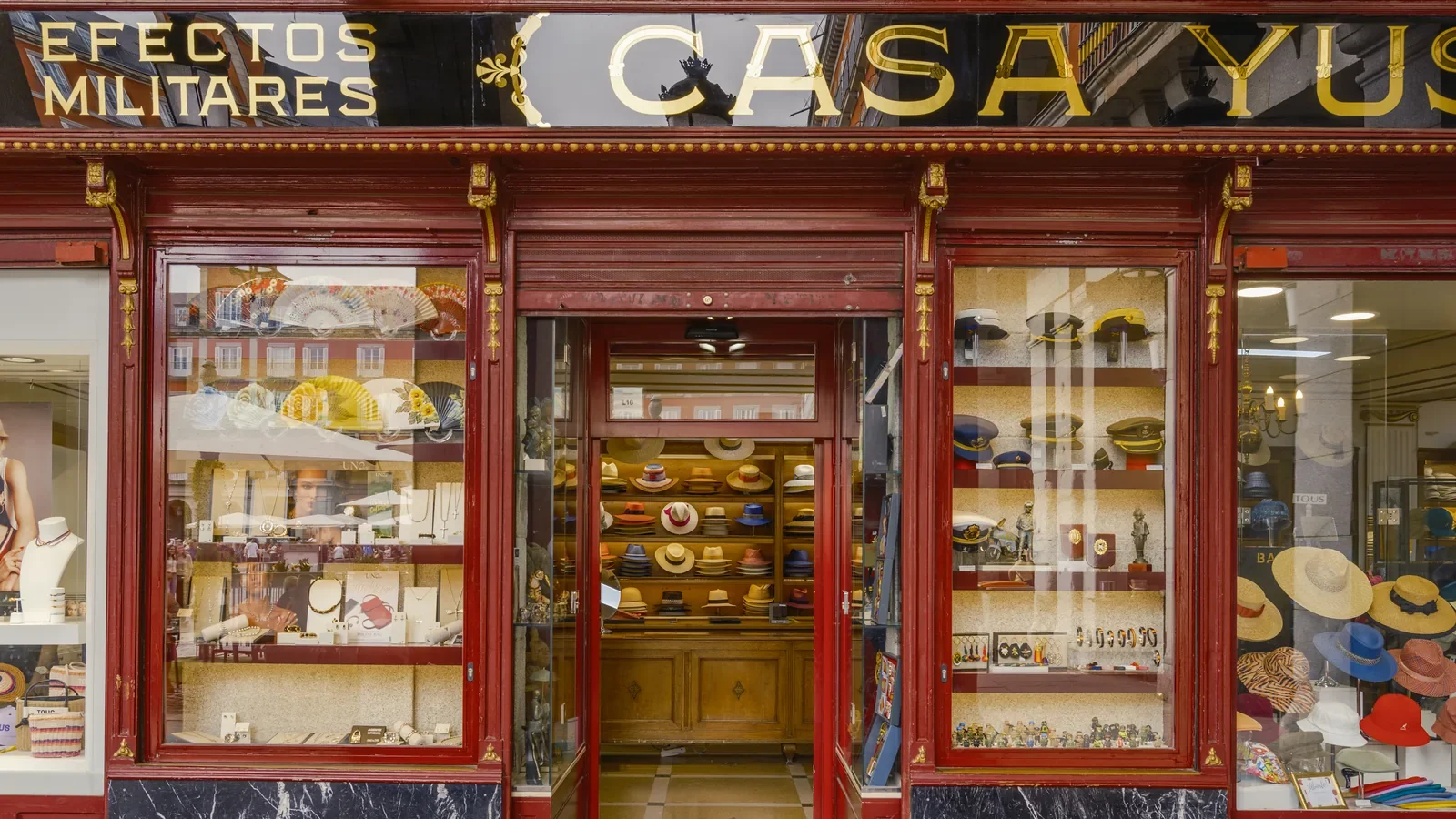
3. A beret — or a flat cap — from Casa Yustas
Casa Yustas has been on Plaza Mayor since 1886, with its original chestnut floor and fittings and a workshop of its own since the twenties. It is a multi-brand hat shop: there are Panamas and Borsalinos here. What I would buy is the small, local end of it — a wool beret at €25, or a flat cap from €19.50.
If you like old shops, Sombrerería Medrano is three minutes away on Calle Imperial. It opened in 1832 and describes itself as the oldest hat shop in Spain.
The trap: none in particular. Only this: the Panama and the Cordobés are not from Madrid. The shop is, and so is the cap.
Where to buy
- Address: Plaza Mayor 30.
- Hours: Monday to Saturday 10:00–20:00 · Sunday 11:00–20:00. The shop does not publish its hours; these come from the city’s own listing.
- Price: basic beret €25.00 · lined fine beret €35.50 · flat cap €19.50–21.50.
- Also: Sombrerería Medrano, Calle Imperial 12, open since 1832 · Monday to Friday 10:00–14:30 and 16:30–20:00 · Saturday 10:00–14:00 · berets €36, hats €23–110.
4. A hand fan from Casa de Diego
The shop on Puerta del Sol has been there since 1860, and the family papers go back to 1823. It sells fans, umbrellas, walking sticks, shawls and castanets, all under the same label: made in Spain, painted by hand. Queen Letizia’s wedding fan was bought here — the city’s listing says so, not me.
I will tell you the awkward part, because I would rather you knew it. Since 1939 the fans of Casa de Diego have been made in Valencia, which is where the craft actually lives. What is from Madrid is the house, the design and that window on Sol. It is still the place to buy a real fan in this city.
They do not publish prices. According to the press, in December 2025, hand-painted fans start at around €30 and climb as far as you want to go. Ask before you fall in love with one.
The trap: the bazaar fan, imported from Asia. The town hall of Aldaia — the Valencian home of the fan — describes those as made at very low cost, with no craft in them. You can see it in the ribs.
Where to buy
- Address: Puerta del Sol 12.
- Hours: Monday to Saturday 9:30–20:00, from the city’s listing.
- Price: not published. Press reports in December 2025 put hand-painted fans from around €30.
- In your suitcase: flat and light. No restrictions.
5. A bottle of Madrid vermouth, or a Vinos de Madrid wine
Vermouth in Madrid is drunk on tap, at midday, with an olive in it. That does not travel. The bottle does, and the two brands made in the region of Madrid are easy to find: Zarro, with a 1968 recipe and a cellar in Fuenlabrada, and Zecchini, born in Lavapiés in 1940 and made today in Valdemoro. The city’s cooks and pastry chefs voted Zecchini the best Madrid product in April 2026.
If you would rather have wine, Madrid has had its own denomination of origin since 1990, DO Vinos de Madrid, with four sub-zones. An M de Monroy from Villamanta costs €8.75 at Mariano Madrueño.
The trap: there is no such seal as “vermouth of Madrid”. What is local is the producer. And the bottle goes in the hold: 75 cl will not pass security.
Where to buy
- Address: Postigo de San Martín 6, by Callao, and Calatrava 19, in La Latina.
- Hours (Postigo de San Martín): Monday to Friday 10:00–15:00 and 16:00–20:30 · Saturday 11:00–15:00 and 16:00–20:30.
- Price: Zarro Reserva 1 L €10.95 · Zecchini Fórmula Original €11.25 · M de Monroy, DO Vinos de Madrid, €8.75. On the producers’ own sites: Zarro, orange or grapefruit, 75 cl €10.45 · Zecchini Rosso Original 75 cl €11.90.
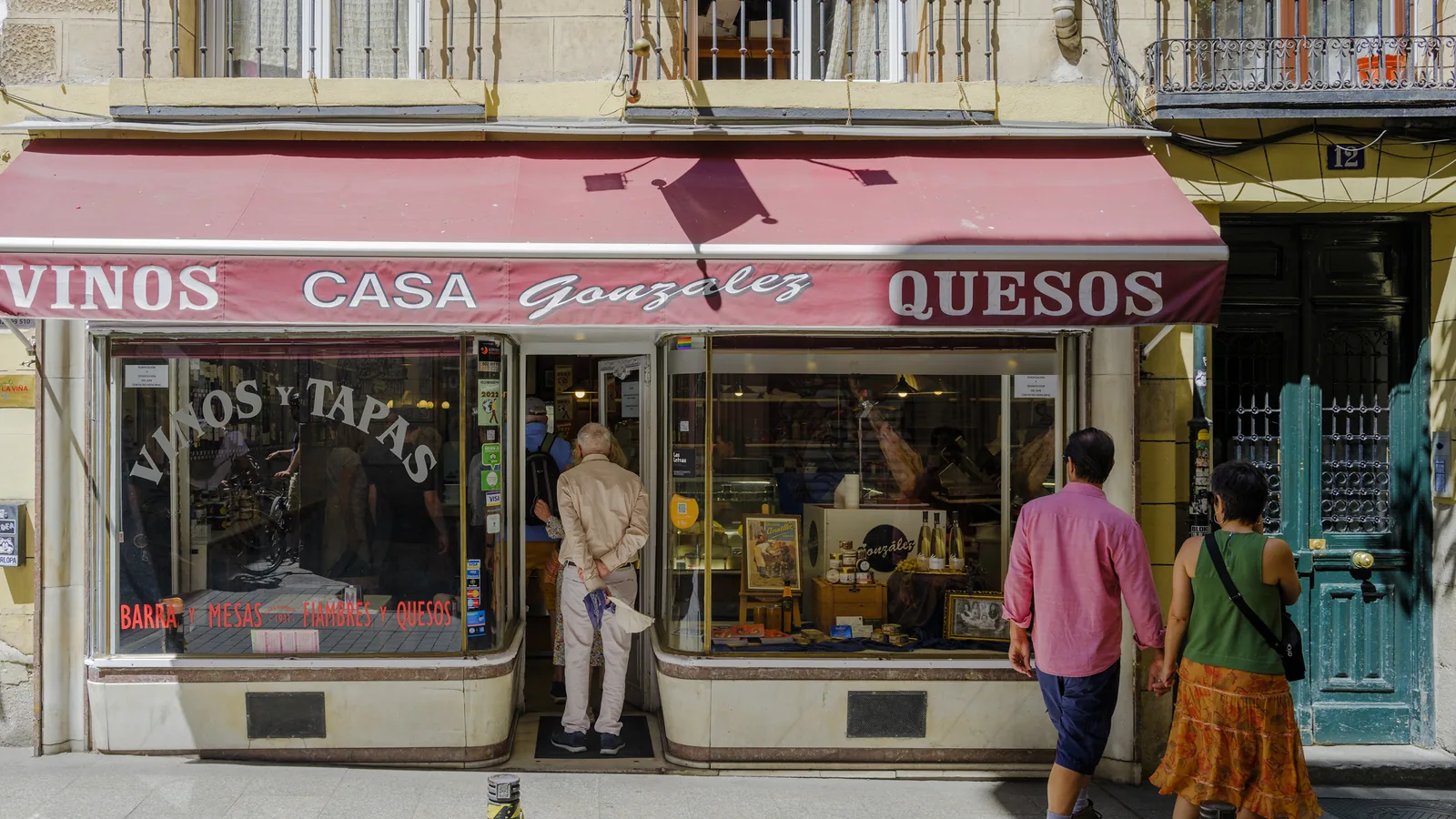
- Also: Casa González, Calle del León 12, selling wine and cheese since 1931, with a bar at the back to try before you buy · Monday to Saturday 10:00–23:00 · Sunday 11:00–23:00.
- In your suitcase: in the hold, wrapped. Country allowances further down.
6. Turrón from Casa Mira
Luis Mira came up from Jijona and set a turrón stall on Plaza Mayor in 1842. The shop on the Carrera de San Jerónimo opened in 1855 and is still in the family, sixth generation, with the royal household among its customers. Jijona turrón is 69% almond and 17% honey and keeps for eighteen months, which makes it the sweet that travels best of everything here.
A block costs between €18 and €26 depending on the format. It is sold all year, not only at Christmas. One warning: the shop closes for the whole of August.
The trap: industrial supermarket turrón in an artisan-looking box. Read the label — the Jijona from Casa Mira is 69% almond.
Where to buy
- Address: Carrera de San Jerónimo 30.
- Hours: every day 10:00–14:00 and 17:00–20:00 · closed in August.
- Price: Jijona turrón €18.00–26.00 depending on format.
- In your suitcase: no problem inside the EU, and allowed into the United Kingdom as chocolate and confectionery. Declare it in Australia and New Zealand. For the United States and Canada there is no rule banning it, but it does not appear on the official lists either.
7. Something from a museum shop
This is not a Madrid souvenir by manufacture, but it is by what it stands for: the Guernica is only at the Reina Sofía and Las Meninas are only at the Prado. The three big museum shops on the Paseo del Prado sell things you will not find outside them.
What I would buy: at the Prado, the museum guide in English at €19.50, or a print from the photographic archive at €16. At the Reina Sofía, anything from the Guernica — the magnet is €4.90. At the Thyssen, a print made to order from €17.
One practical detail. The Prado shop can only be entered with a museum ticket. The Thyssen shop is free to walk into. The Reina Sofía closes on Tuesdays.
The trap: the Meninas sold off a street stall are not archive reproductions. The museum ones are.
Where to buy
- Museo del Prado: shop in the Villanueva–Moneo hall, by the Jerónimos door · Monday to Saturday 10:00–20:00 · Sunday and holidays 10:00–19:00 · museum ticket required · guide €19.50, prints €16.
- Museo Reina Sofía: Monday 10:30–20:45 · closed Tuesday · Wednesday to Saturday 10:30–20:45 · Sunday 10:30–14:15 · Guernica magnet €4.90, bookmark €1.50, T-shirt €42.
- Museo Thyssen-Bornemisza: Paseo del Prado 8 · free entry to the shop · Monday 12:00–16:30 · Tuesday to Saturday 10:00–19:30 · Sunday 10:00–19:10 · print to order from €17, bags €12–45.
8. Something designed and made in Madrid
This is the Madrid of now. In the Barrio de las Letras, Postal y Tinta is a shop and press in one, printing postcards and illustrations of the city on an etching press: a postcard is €3, a pack of ten €25. It is what I post from here.
If you prefer ceramics, Lavapiés has two workshop-shops where the work is made on the premises: D’A Ceramics, Déborah Abizanda’s porcelain, on Doctor Fourquet, and Arte Hoy, raku and tableware for cooks, on Calle de la Cabeza. And on Plaza Mayor itself, the municipal shop in the Casa de la Panadería sells souvenirs made by local craftspeople, chosen by the council under its Hecho en Madrid programme.
The trap: the concept stores in Malasaña and Conde Duque sell European and Asian design. The verifiably made-in-Madrid part is in the workshops and in the municipal shop.
Where to buy
- Postal y Tinta: Calle de la Alameda 8 · Monday to Friday 10:00–15:00 and 16:00–19:30 · Saturday 10:30–18:00 · postcard €3, pack of 3 €8, of 5 €13, of 10 €25.
- D’A Ceramics: Calle del Doctor Fourquet 35 · Monday 17:30–20:00 · Tuesday to Thursday 11:30–14:30 and 17:30–20:00 · Saturday 10:30–14:30 · prices in the shop.
- Arte Hoy: Calle de la Cabeza 26 · Monday to Friday 10:00–14:00 and 17:30–20:00 · Saturday 11:00–14:00 · prices in the shop.
- Casa de la Panadería municipal shop: Plaza Mayor 27 · every day 10:00–20:00 · prices in the shop.
9. Leather gloves from Varadé
Guante Varadé has been the glove house of Madrid since 1902: first a workshop in the Rastro, then the shop on Calle Montera, then a gold medal at the 1929 Barcelona exhibition. The war moved the factory to Aranda de Duero, in Burgos, and there it stayed. What is left in Madrid is the house, the family — fourth and fifth generation — and the shop on Calle de Serrano. Again, I tell you so that you know.
It is the only item on this list outside the old centre, and the most expensive: a pair of short leather gloves for women costs €65. If you are here in winter, it is a purchase you will use.
The trap: none. Only the price, which is the price of a glove built to last.
Where to buy
- Address: Calle de Serrano 54, in the Salamanca district.
- Hours: Monday to Saturday 10:00–20:30.
- Price: short leather glove, women’s, €65.00 · mid-length €80 · mitten €80.
- In your suitcase: no problem.
10. Convent sweets through the hatch at Las Carboneras
On Plaza del Conde de Miranda, two streets from Plaza Mayor, the Hieronymite nuns of the Corpus Christi convent — Las Carboneras, there since 1607 — sell their sweets through a wooden hatch. You do not see them. You ring, you ask, and the hatch turns with the box on it. Mantecados from Jerez, naranjines, sequillos, nevaditos, tea and almond biscuits, in one-kilo boxes.
It is the oldest purchase on this list and the hardest to explain when you get home. Go in the morning.
The trap: there is none. Only the hours, which are a convent’s hours.
Where to buy
- Address: Plaza del Conde de Miranda 3.
- Hatch hours: 9:30–13:00 and 16:30–18:15.
- What they sell: mantecados from Jerez, naranjines, sequillos, nevaditos, tea and almond biscuits, in 1 kg boxes.
- In your suitcase: dry baking. Declare it in Australia and New Zealand. The United Kingdom allows baked goods without unprocessed dairy.
11. Strings and a capo from Guitarras Ramírez
José Ramírez opened his workshop in 1882 and founded what guitar makers call the Madrid school. Andrés Segovia played Ramírez guitars. The fifth generation runs it now, and the handmade instruments are built in the workshop in Tetuán, with a label signed by the master.
A handmade guitar starts at €4,919, and it sits in the box below. What fits in any suitcase and any budget is what the house itself sells as a keepsake: a set of Ramírez strings at €19–31, a handmade capo at €37, or a handful of picks at €2. For anyone who plays, it is the best gift on this list.
The trap: the Spanish guitar from a souvenir shop, imported. It is neither Spanish nor a guitar.
Where to buy
- Address: Calle de la Paz 8, beside Sol. The workshop, on General Margallo 10, is by appointment only.
- Hours: Monday to Friday 10:00–14:00 and 16:30–20:00 · Saturday 10:00–14:00.
- Price: strings €19–31 · handmade capo €37 · picks €2 · the book En torno a la guitarra €27.
- In your suitcase: no problem.
If you are serious: what costs more than €100
If you’re serious
- A cape from Capas Seseña, since 1901: Calle de la Cruz 23 · Monday to Friday 10:00–20:00 · Saturday 10:30–14:30 · closed 9 to 24 August · the classic 1901 merino cape €1,200, with models from €540 to €2,100. Cut and sewn in Madrid; Picasso, Buñuel and Fellini wore one.
- A handmade Ramírez guitar: Calle de la Paz 8 · from €4,919 for the Preludio to €29,400.
- A Panama or a montera from Casa Yustas: Plaza Mayor 30 · Panamas €99–790 · montera €199.
- A made-to-measure shirt from Camisería Burgos, since 1906: Calle de Cedaceros 2 · Monday to Friday 10:00–20:00 · Saturday 10:00–14:00 · August, ask · shirt €180, guayabera €190.
- Loewe, the leather house born in Madrid in 1846: Casa Loewe, Calle de Serrano 34 · Monday to Saturday 11:00–20:30 · Sunday 12:00–19:30. No price to give you.
From Spain, with a shop in Madrid
The four everyone expects, and none of them is from here. I put them in because you may want them, labelled for what they are.
- Saffron. It is from La Mancha, under the DOP Azafrán de La Mancha: Albacete, Ciudad Real, Cuenca and Toledo. Threads only, with a numbered back label, never loose. It runs €12–13.40 a gram. In Madrid: La Melguiza, Calle de Santiago 12, between Ópera and the San Miguel market.
- Ham. From Guijuelo, Jabugo, Extremadura or Los Pedroches. What is local is the ham shop in the centre. Vacuum packs at the Museo del Jamón on Carrera de San Jerónimo 6, Sunday to Thursday 9:00–23:30 and Friday to Saturday 9:00–00:30, sliced 100% acorn-fed ibérico from €12.90. Or at Julián Becerro, a Guijuelo producer since 1930, at Cava Baja 41, where 100 g cut by knife is €16. The black tag is 100% acorn-fed ibérico; the white one is grain-fed.
- Talavera ceramics. From Talavera de la Reina and Puente del Arzobispo, an hour and a half away; the craft has been on the UNESCO list since 2019. In Madrid it has been sold since 1904 by the Antigua Casa Talavera, Calle de Isabel la Católica 2, Monday to Friday 10:00–14:00 and 17:00–19:45, closed Saturday. It does not make the pieces. It chooses them from small potteries, and it chooses well.
- Mantón de Manila. It came from the Philippines and China by way of Seville, and in Madrid it is worn at San Isidro. Embroidered by hand at Casa de Diego, Puerta del Sol 12, price in the shop.
Watch out
Ham does not fly to the United States, the United Kingdom or New Zealand
It makes no difference that it is vacuum-packed, stamped, or bought in the duty free. The United States agriculture service, APHIS, bans travellers from bringing in Spanish cured ham and salami; it enters only as a commercial shipment. Since 12 April 2025 the United Kingdom bans all pork, beef and lamb and all dairy from the EU. New Zealand names Iberian jamón on its prohibited list.
Declare it and it is taken off you, and nothing else happens. Do not declare it and the fine runs to $1,000 in the United States, £5,000 in England and NZ$400 on the spot in New Zealand. Canada takes cooked, packaged meat only. Australia requires you to declare and decides at the counter. Inside the EU, there is no restriction.
Where to buy Madrid souvenirs: three streets and one market
If you have a morning, almost all of the above is walkable.
Calle de Toledo, coming down from Plaza Mayor: Casa Hernanz at number 18 and, on the same pavement, four shoe shops with centenary plaques — Calzados Toledo from 1857 at number 20, Calzados Lobo from 1897 at 30, Carballo from 1908 at 38, Casa Vega from 1860 at 57. This is the street where Madrid did its shopping before shopping centres existed.
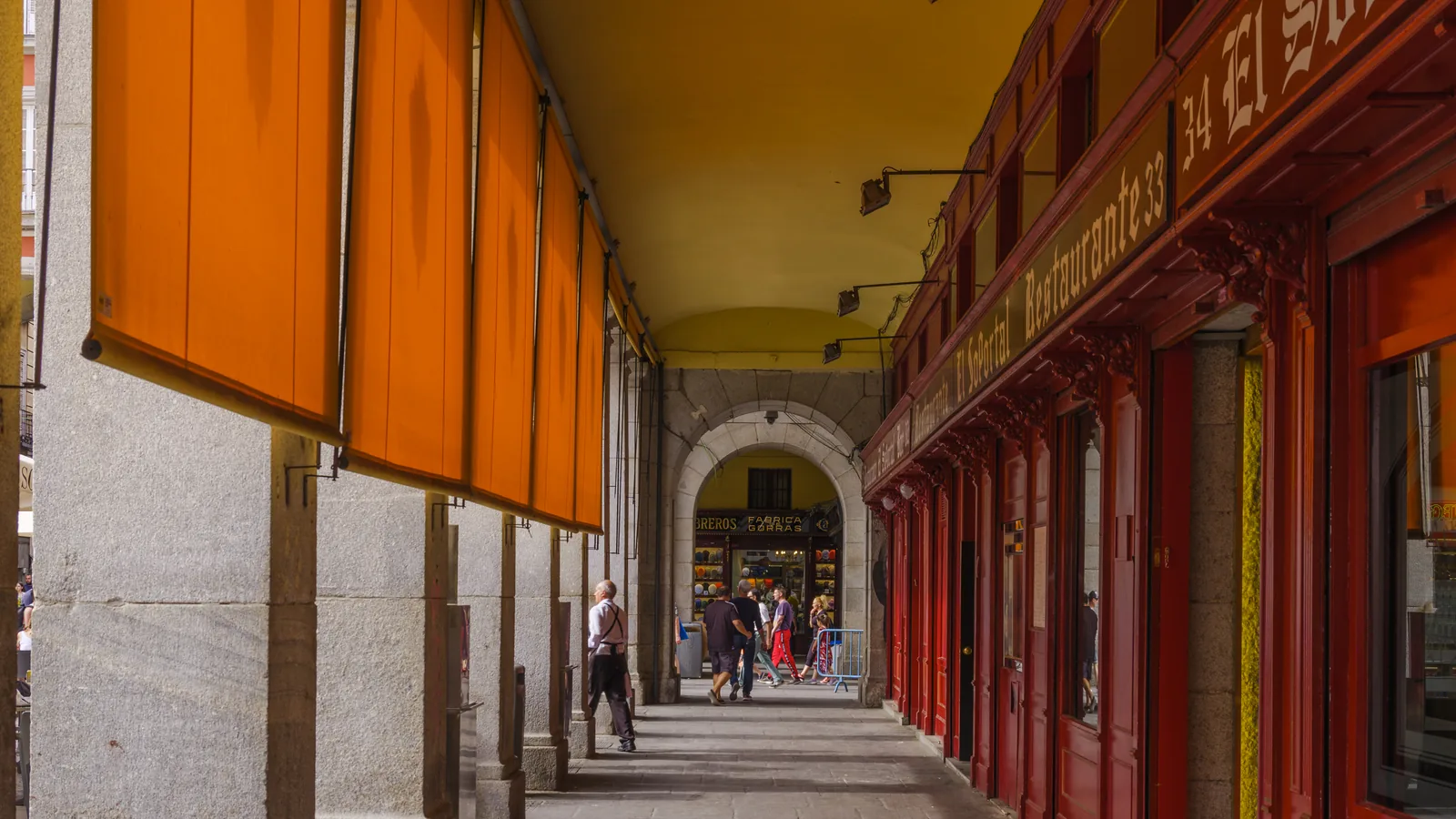
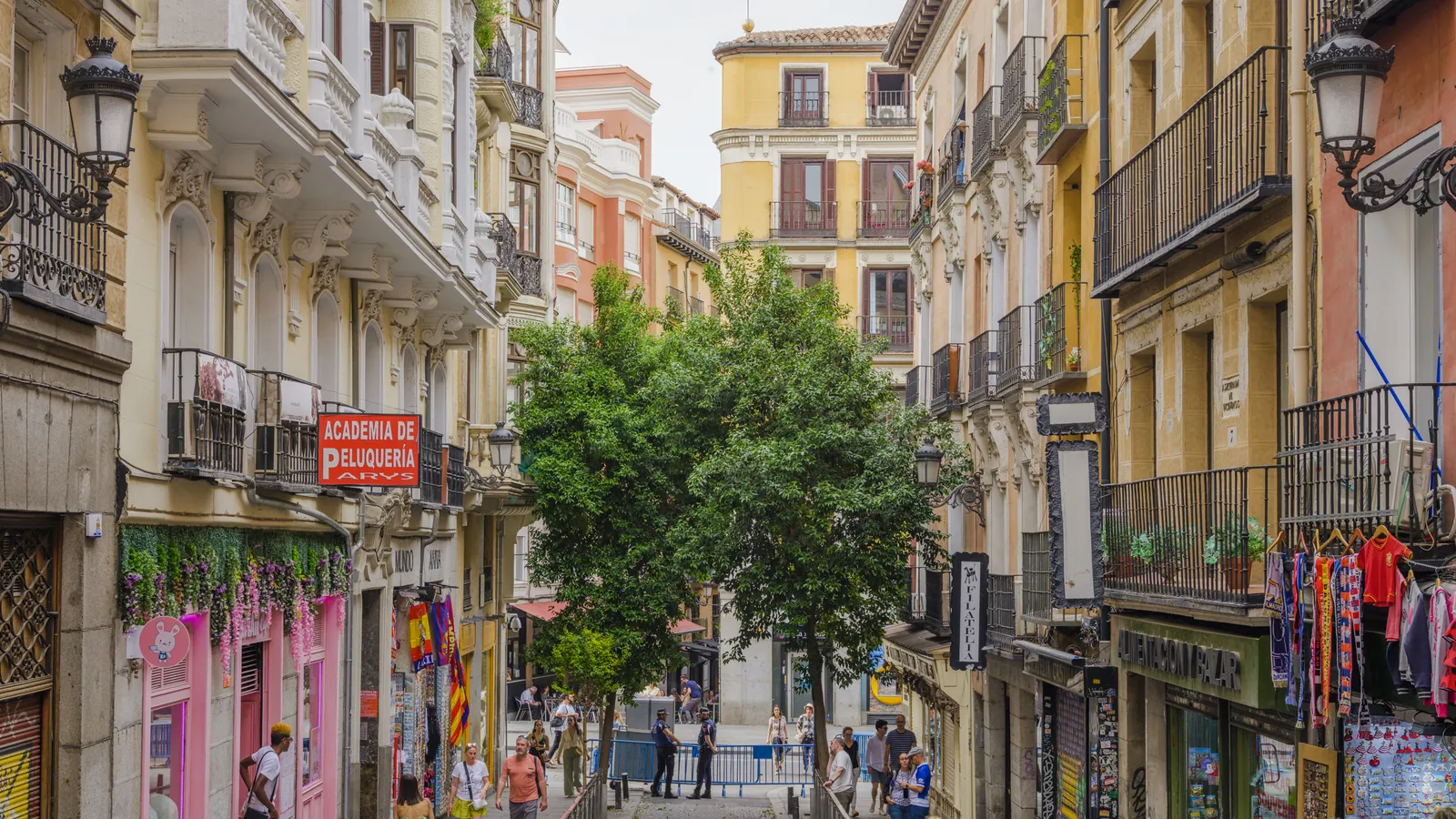
Plaza Mayor and around it: Casa Yustas at number 30, the municipal shop in the Casa de la Panadería at 27, Sombrerería Medrano on Imperial 12 and, two streets down, the hatch at Las Carboneras. It is the same square that turns up more than once in the three-day plan I would follow.
The Cruz–León–Canalejas triangle, between Sol and the Barrio de las Letras: La Violeta on Canalejas, Casa Mira on the Carrera de San Jerónimo, Guitarras Ramírez on Calle de la Paz, Capas Seseña on Cruz and Casa González on León. All of it within five minutes of itself.
The market: El Rastro, on Sundays and public holidays from 9:00 to 15:00, around Plaza de Cascorro and Ribera de Curtidores.
Football, if you are looking for it: the official Real Madrid shops are on Gran Vía 31, Carmen 3 and Arenal 6, and the Atlético one on Gran Vía 47. The official shirt costs €100 and €109.99 respectively. The ones at €15–25 on the stalls around Sol are not official.
Which of the three streets you start from depends on which neighbourhood you are sleeping in. And if you would rather have someone point these out as you pass, that is more or less what I do for a living — the Hidden Madrid Bike Tour covers this part of the city.
Taking it home: customs, liquids and the VAT refund
This is the part no souvenir list covers, and the part that saves the most grief. Three things: what your country lets in, what has to go in the hold, and how to claim back the 21% VAT if you live outside the EU.
Official rules, checked on 25 August 2026. Declare anything edible, always.
Customs
- United States: ham banned · cheese allowed · turrón, no rule banning it · saffron allowed · 1 L of alcohol · fine up to $1,000.
- United Kingdom: ham banned since April 2025 · cheese banned · turrón allowed · saffron, no documented restriction · 18 L wine and 4 L spirits, or 9 L at 22% or less, which covers vermouth · fine up to £5,000.
- Australia: declare the ham and the inspector decides · declare cheese, sweets and saffron · 2.25 L of alcohol · fine A$660–3,960, and it can cost you the visa.
- Canada: cooked and packaged meat only · pasteurised cheese allowed · sweets and saffron allowed · 1.5 L wine or 1.14 L spirits · fine up to C$1,300.
- New Zealand: ham banned · cheese allowed up to 2 kg · declare the sweets · saffron allowed, sealed and packaged · 4.5 L wine and 3 bottles of spirits · NZ$400 on the spot.
- Another EU country: all of it allowed, with no limit for personal use.
New Zealand also bans honey. And the United Kingdom bans all EU dairy, which means the cheese from Casa González stays in Madrid.
Liquids. The 100 ml cabin limit still applies at Barajas, new scanners or not. Vermouth, wine and oil go in the hold, wrapped. They only travel in the cabin if you buy them after security, in a sealed bag with the receipt inside.
The VAT. If you live outside the EU — the United Kingdom included, other EU residents not — you can claim back the VAT on what you buy. There is no minimum purchase. It works like this: ask the shop for the invoice and the DIVA document, with your passport; at Barajas, before you check your bags and with the purchases to hand, validate the DIVA at a kiosk — there are kiosks in T1, T2, T4 and T4S, and the T4S office is open around the clock; then collect at the refund desks in the terminal or back at the shop. The kiosks and the refund operators take a commission that is not published, so on small purchases it may not be worth the queue.
Heads up
The bottle goes in the hold. The DIVA goes before check-in.
One hundred millilitres is the limit at Barajas, even where the new scanners no longer ask you to take liquids out of your bag. A bottle of vermouth or wine will not pass security: wrap it and check it in.
If you are claiming the VAT back, do it before you drop the bag: the DIVA kiosk wants to see what you bought. No minimum purchase, passport in hand, and only if you live outside the EU.
What I would not buy
- Football shirts at €15–25. They are not official; the official one costs €100. If you are not going to pay that, do not buy one.
- Powdered saffron, or colorante, at €1–3 a sachet. It is not saffron. It is safflower or turmeric. The real thing comes in threads, with a back label, and costs more than €10 a gram.
- Bazaar fans. Imported, with no craft in them. If you want one, Casa de Diego.
- Espadrilles with a synthetic sole. At €11.50 for the Hernanz ones, there is no excuse.
- The €1 ham sandwich ham. That is serrano, from white pigs. And if you are flying to the United States, the United Kingdom or New Zealand, no ham at all.
- Screen-printed Talavera-style tiles. The Antigua Casa Talavera sells the real ones.
If you are still putting the trip together, the rest of my Madrid guides are in the same place.
Everything on this list was made for somebody else: the espadrilles for the farmhands coming down to Plaza Mayor, the capes for winters nobody heats any more, the convent sweets for a hatch that has been turning since 1607. You are simply the person who walked in and asked. That is what makes them worth carrying home.
Frequently asked questions
What is Madrid famous for shopping?
The things that are actually from here: espadrilles from Casa Hernanz, violet sweets from La Violeta, turrón from Casa Mira, Zarro or Zecchini vermouth, a beret from Casa Yustas, a capo from Guitarras Ramírez. Ham, saffron and Talavera ceramics come from other parts of Spain, even if Madrid is a good place to buy them.
Which is the best souvenir shop in Madrid?
There is not one. The best buying is spread over three streets — Toledo, Plaza Mayor, and the Cruz–León–Canalejas triangle — and one market, El Rastro on Sunday. All of it in the centre, on foot.
Can I take jamón to the United States or the United Kingdom?
No. The United States bans travellers from bringing in Spanish cured ham, vacuum-packed or not. Since April 2025 the United Kingdom bans all pork and all dairy from the EU. New Zealand does the same. Declare it and it is confiscated with no fine; do not declare it and the fine reaches $1,000 or £5,000.
Can I claim the VAT back on what I buy in Madrid?
Yes, if you live outside the EU, the United Kingdom included. There is no minimum purchase. Ask the shop for the invoice and the DIVA document with your passport, and validate it at a DIVA kiosk at Barajas before you check your bags, with the purchases to hand. Residents of other EU countries cannot.
What is a cheap souvenir from Madrid?
A box of violet sweets at €2.70, a pair of Casa Hernanz espadrilles at €11.50, the Guernica magnet from the Reina Sofía shop at €4.90, a postcard printed in Madrid at Postal y Tinta at €3, or a set of Guitarras Ramírez strings from €19. Prices from August 2026.
Does the Prado have a shop?
Yes, in the hall by the Jerónimos door, but you can only get in with a museum ticket. The Thyssen shop, at Paseo del Prado 8, is free to walk into. The Reina Sofía shop closes on Tuesdays.