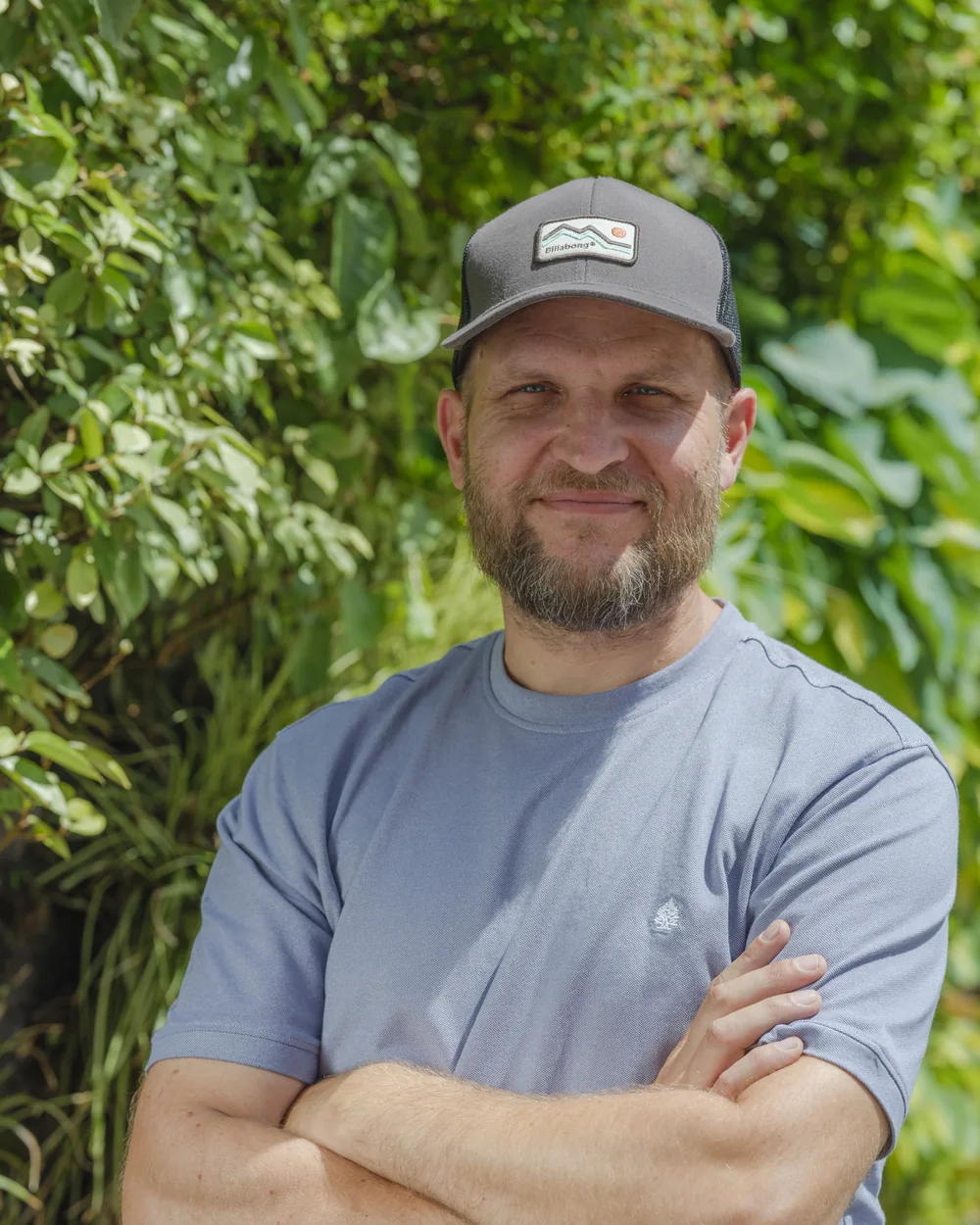

There are two kinds of 3-day Madrid itineraries on the internet: the kind written after a week of research from a flat in Berlin or Sydney, and the kind written after twelve years of crossing Madrid — five of them by bike, at eight in the morning. This is the second kind.
Are three days in Madrid enough? Yes. You won’t see everything — that doesn’t exist in any city — but it’s enough to understand how the city works, eat well three times a day, and go home with the feeling of having travelled the city, not just passed through it. That said, it also depends on your style, and on how you like to get to know a place.
One thing I’ll tell you before you read on: if these 3 days are all you have, forget about adding Toledo or Segovia. Both are an hour from Madrid, and both are monumental cities carrying serious history. With three days, there’s no room in your schedule; better to stay in Madrid and do it well. That’s my honest opinion.
One more thing before we start: I don’t sell through the usual platforms. I have no affiliate links to hotels, or to any website that isn’t mine or the official one where you book your ticket in advance. In short: I’d rather lose a (ridiculous) commission than lose a reader who’s after the same advice I give at the end of my tours. And yes — this article isn’t designed to keep you with me as long as possible; it’s designed to solve your trip.
What you will find: an itinerary that assumes you land jet-lagged on day one, that tells you when not to go into a place, which neighbourhoods to skip if three days is what you have, and where to sit down at four in the afternoon on a Tuesday in July or August, when the centre burns (if it burns) at 38 °C.
Three days is a shape, not a rule. If your trip looks different — more days, fewer, a second visit — pick what fits from things to do in Madrid.
The itinerary on one map
I’ve put every stop, bar, restaurant and viewpoint mentioned here on an interactive map. It’s organised by day — you can switch the layers on and off depending on the day you’re on. Keep it open on your phone while you walk.
Let’s go.
Before you start: getting around Madrid, and what to expect
Madrid is walkable in the centre. The historic quarter fits inside a rectangle you can cross on foot in about half an hour, and ninety per cent of the monuments, buildings and museums sit inside it.
The rhythm is different from the Anglo-Saxon one: lunch is late, dinner is later, the terrazas fill up at eleven at night, and the museums close on Mondays (some of them). In summer it gets properly hot — not European hot; dry, high-plateau hot — and that changes or pauses the itinerary, though it doesn’t cancel it.
The metro is good, but sometimes you spend longer going down and up the stairs than you would crossing that same rectangle on foot. In summer you have two options: take the metro, or cross the rectangle making refuelling stops at every bar along the way, enjoying a well-poured caña. Spoiler: you already have your first trick for becoming a madrileño.
Day 1: Madrid de los Austrias and the historic heart
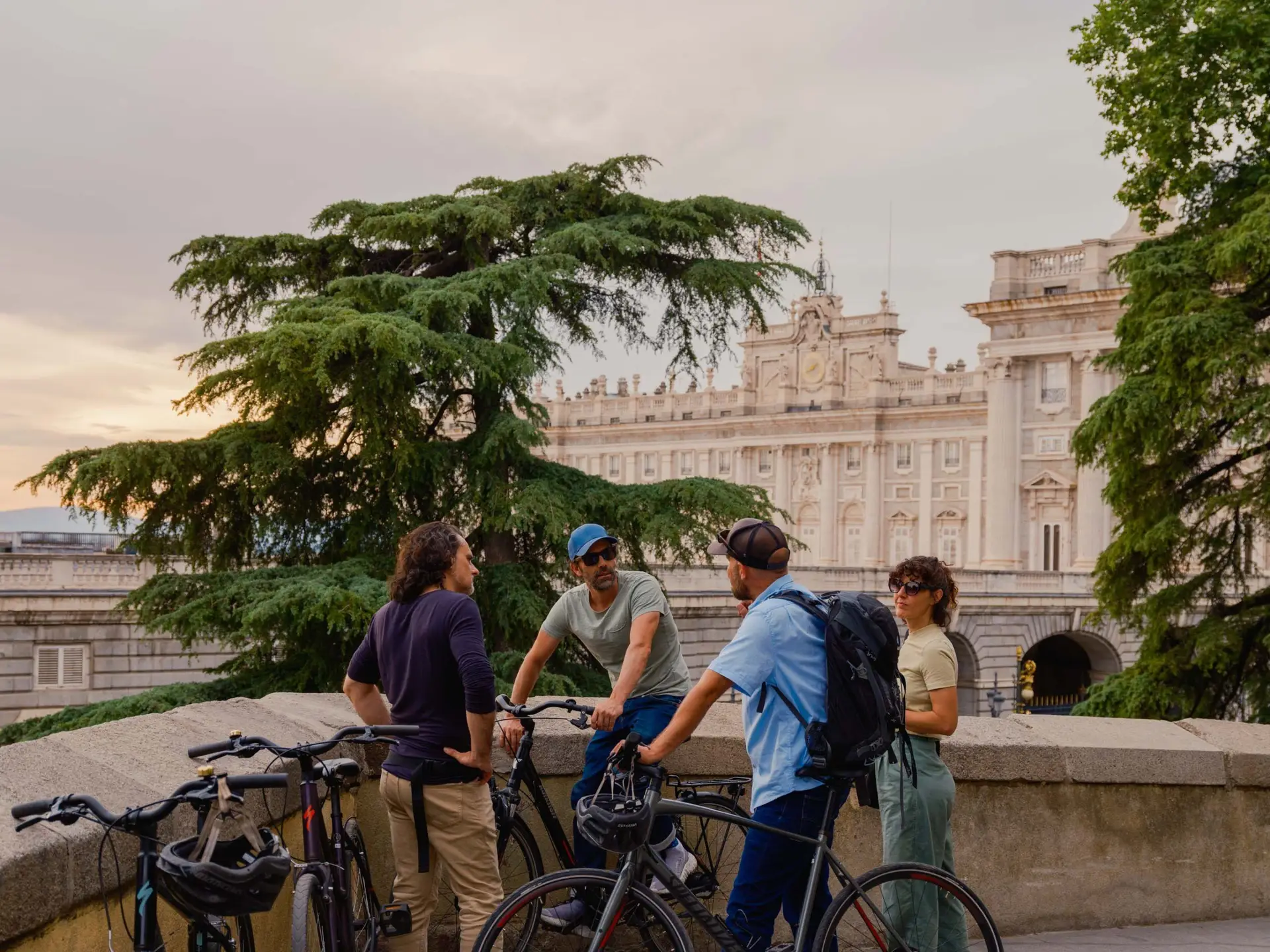
You can start at Sol (Puerta del Sol) or at Ópera. The difference? Start at Sol and you’ll be walking the route backwards before it has begun; start at Ópera and you set off from the Royal Palace and discover it as you go. You decide.
- Metro: L1, L2 and L3
- Cercanías (commuter rail): C3, C3a, C4-a and C4-b — the C3a runs to the Monastery of El Escorial — a day trip that does not fit into three days, but worth knowing if you come back
On the ground, in front of the Comunidad de Madrid building, is Kilometre Zero: the plaque from which all of Spain’s radial roads are measured. You’ll see a crowd milling around it, waiting for a photo. Look at it, take the photo if you must, and move on.
Take Calle Mayor heading west. Ten minutes on foot, downhill almost all the way, and Plaza de la Armería opens up with the Royal Palace at the far end.
- Metro: L2, L5 and Branch R
Facing the Teatro Real, take Calle de Vergara (the street on the left) and keep straight. You can’t miss it: you’ll come face to face with the Palace. Once there, follow the left side until you reach Plaza de la Armería, with the main entrance at the far end.
The honest question about the Royal Palace: go in or stay outside?
If you’ve seen Versailles, Schönbrunn or any other European royal palace, the interior will taste like more of the same. If you haven’t and you’re curious, go in: the visit takes two hours and you’ll come out understanding why the Philippines are named after Felipe II and how far the Spanish Empire reached. That’s worth something.
What almost nobody tells you: the Campo del Moro, the gardens on the west side, are free and they’re the best part of the whole complex. Views of the Palace from below, real shade, fewer people. If you have to choose just one thing, choose the gardens. One caveat: they pull you off the route — if you’re short on time, save them for another walk.
- April to September: Monday to Saturday, 10:00 AM to 7:00 PM
- October to March: Monday to Saturday, 10:00 AM to 6:00 PM
- Sundays: 10:00 AM to 4:00 PM, year round
- Note: occasional closures for official ceremonies
- Admission: €18 · reduced €9
- Royal Palace tickets, official site
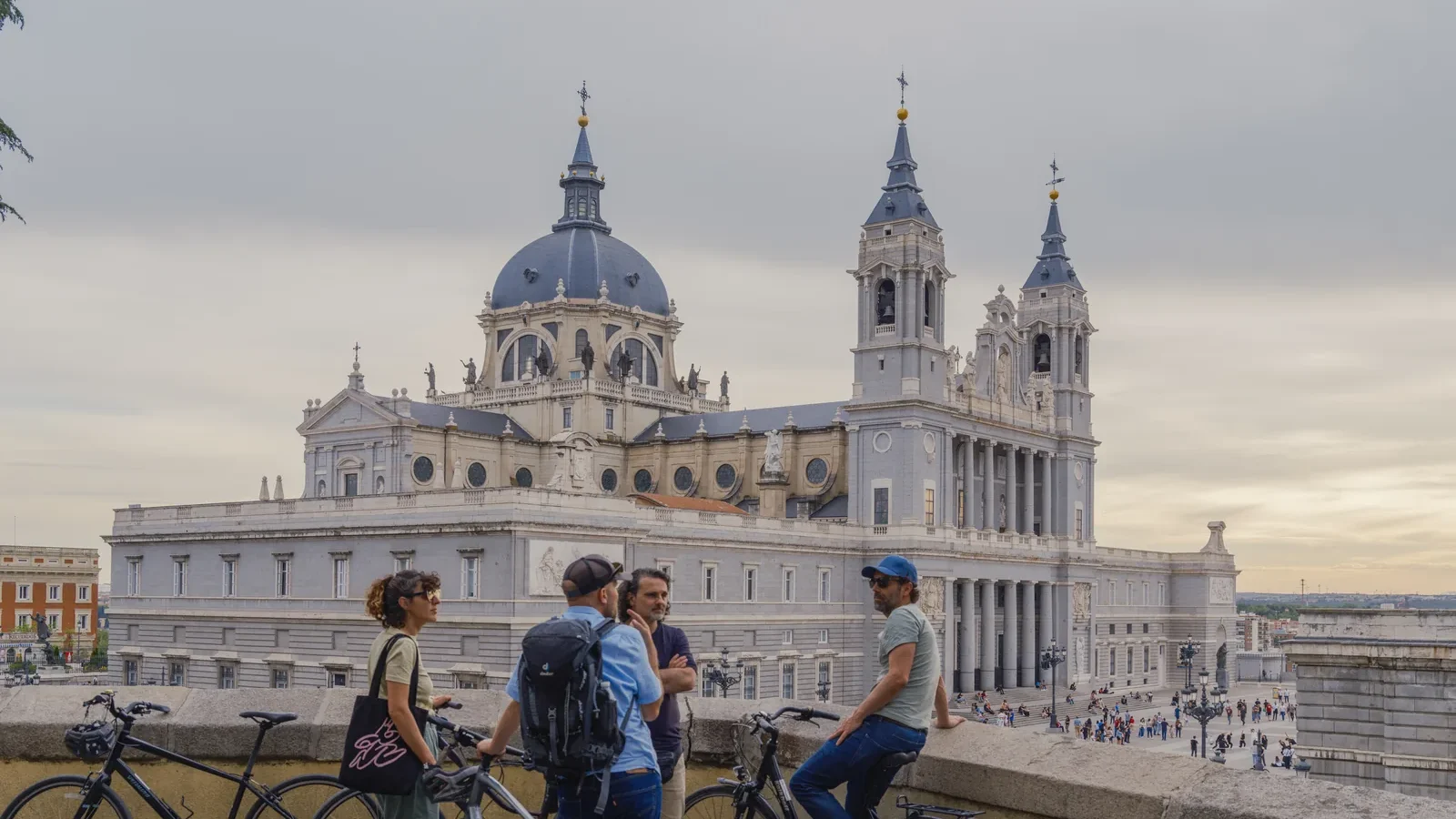
Across Plaza de la Armería is the Almudena Cathedral. It’s free, and it doesn’t need more than twenty minutes. It’s a relatively modern cathedral — finished in 1993 — and it shows. Go in, look, come out. What is worth it is going up to the cathedral viewpoint, reached from Calle del Factor: a good view of the Palace with the Cathedral facing it.
The cathedral viewpoint on Google Maps
If you want to sit down for lunch between the Palace and Plaza Mayor, here are two places. If you’d rather grab something on the move, wait for Plaza Mayor.
- A terraza — the one with the black parasols — with views of the Palace and a menu of pintxos, small bites on bread, Basque style, with interesting set combinations.
- La Taberna de Ramales on Google Maps
- A bar with a very decent set menu between €10 and €20.
- Arbonaida Bar’s menu
- Arbonaida Bar on Google Maps
On the way to Plaza Mayor, stop at Plaza de la Villa: the buildings gathered there add up to 600 years between them — the old town hall alone is 400 years old and was Madrid’s official seat of government from 1629 until 2007.
Just before you enter Plaza Mayor, you’ll see the Mercado de San Miguel on your right. If it’s open, it’s worth stepping inside: the 1916 iron building is still beautiful — iron from the era of Gustave Eiffel, ring a bell? But go in with clear expectations. This is a market not even the neighbour across the street walks into for a coffee. It’s a textbook premium tourist trap, not a neighbourhood market: the prices reflect that, and the quality is uneven. The atmosphere is worth a fifteen-minute pass; eating there is another story. The old shops around this square are a morning of their own: the Madrid souvenirs worth taking home.
If you want a real market with good food at normal prices, the Antón Martín market in Lavapiés is the opposite: neighbourhood, locals, stalls without marketing.
The Plaza Mayor rule
Plaza Mayor is beautiful, yes. It’s also full of restaurants with laminated menus in six languages at €35 that will serve you frozen prawns. The simple rule: you don’t eat in Plaza Mayor. The one reasonable exception is the bocadillo de calamares — the fried squid sandwich, real Madrid food from way back — and you eat it on the move.
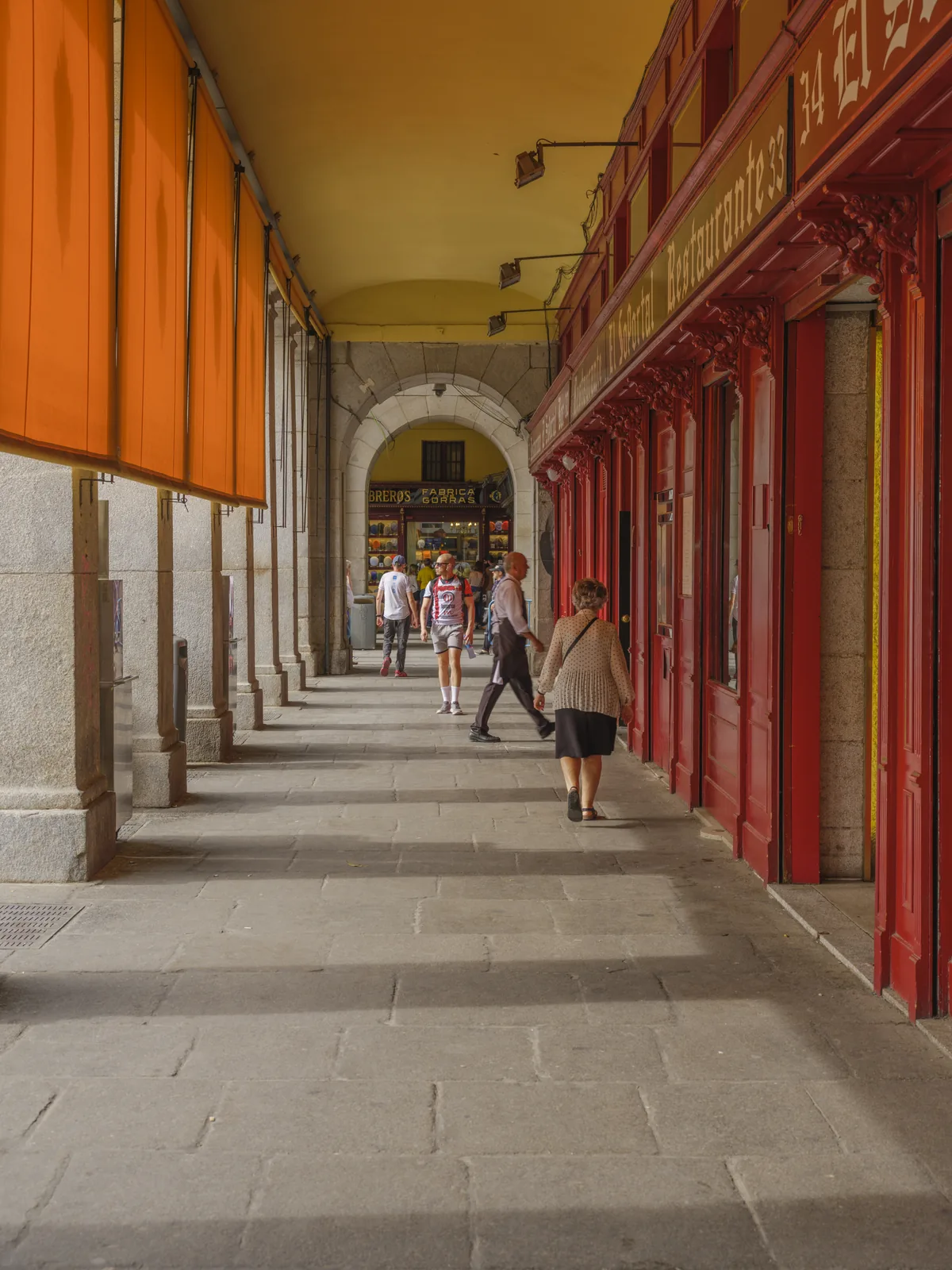
You may have heard or read about Bar La Campana and its squid sandwiches. Don’t bother: in high season the queue is as long as a supermarket checkout’s. The same sandwich, same squid, same size is served under the arcades or in one of the cave-bars around the square — and they take cards. If you do go to La Campana, bring cash.
- At the entrance to the square, just before the arch, in the right-hand arcade. It goes unnoticed and there’s no queue — and you’ll learn how to order at a Spanish bar.
- Bar Valle del Tiétar on Google Maps
Take a stroll, browse the shop windows under the arcades, look without hurrying. And when you’ve seen enough, leave through the Arco de Cuchilleros: the southwest corner, down the steps. At the foot of the arch begins Cava Baja.
Letting yourself drift down Cava Baja
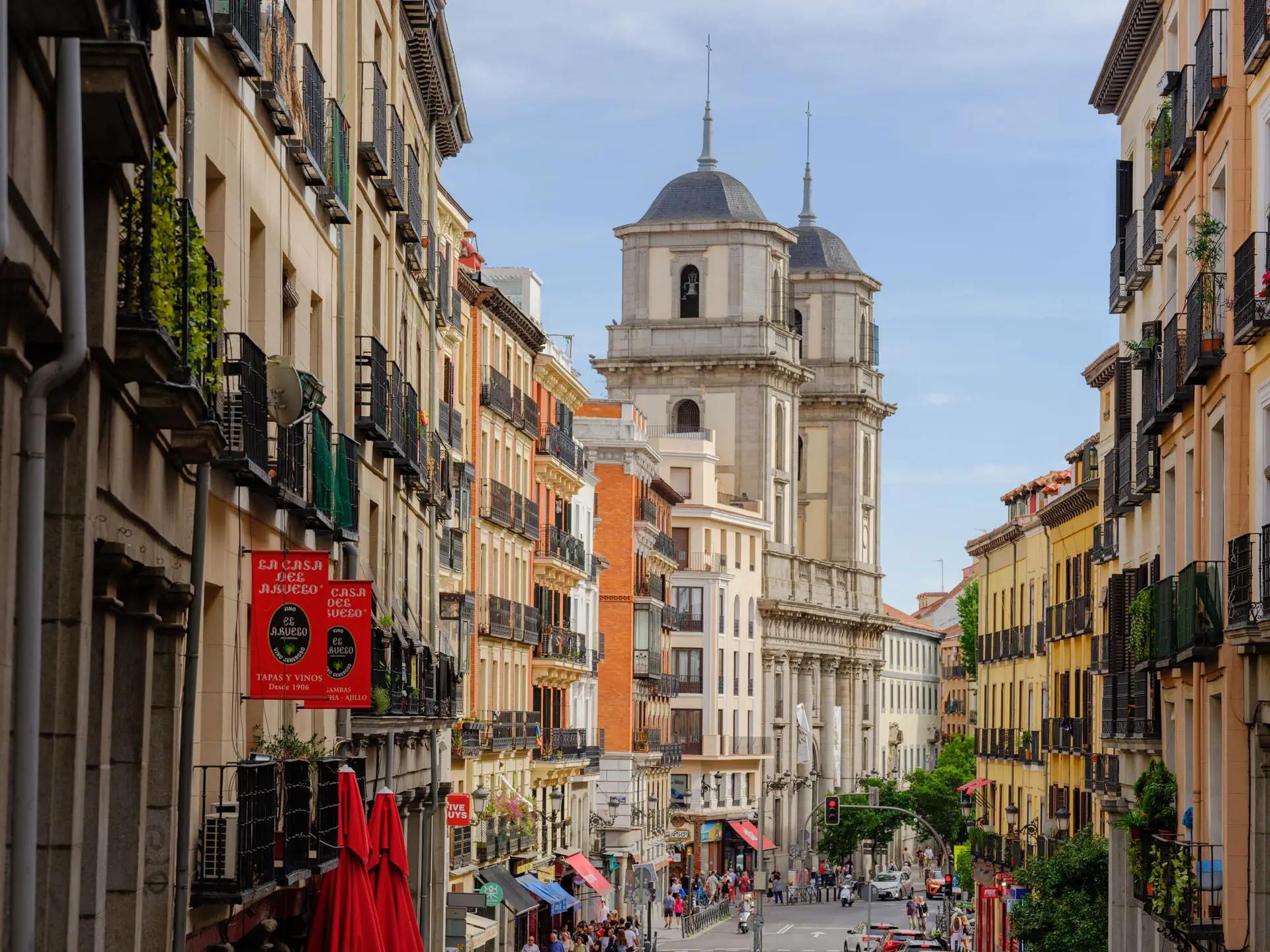
From the steps of the Arco de Cuchilleros, let yourself drift towards Cava Baja. If you haven’t eaten yet, there are thirty-odd bars here and I’m not going to recommend one. Not because I don’t want to — because the logic of the neighbourhood, of Madrid and of Spain, is a different one: you don’t go to a bar, you do a route. A caña — a small draught beer — and a tapa in one, a shared ración in the next, another caña in the one after that. The point is to keep moving, not to stay. Walk into whichever one has people at the bar. It will work — and that way the first day ends on its own.
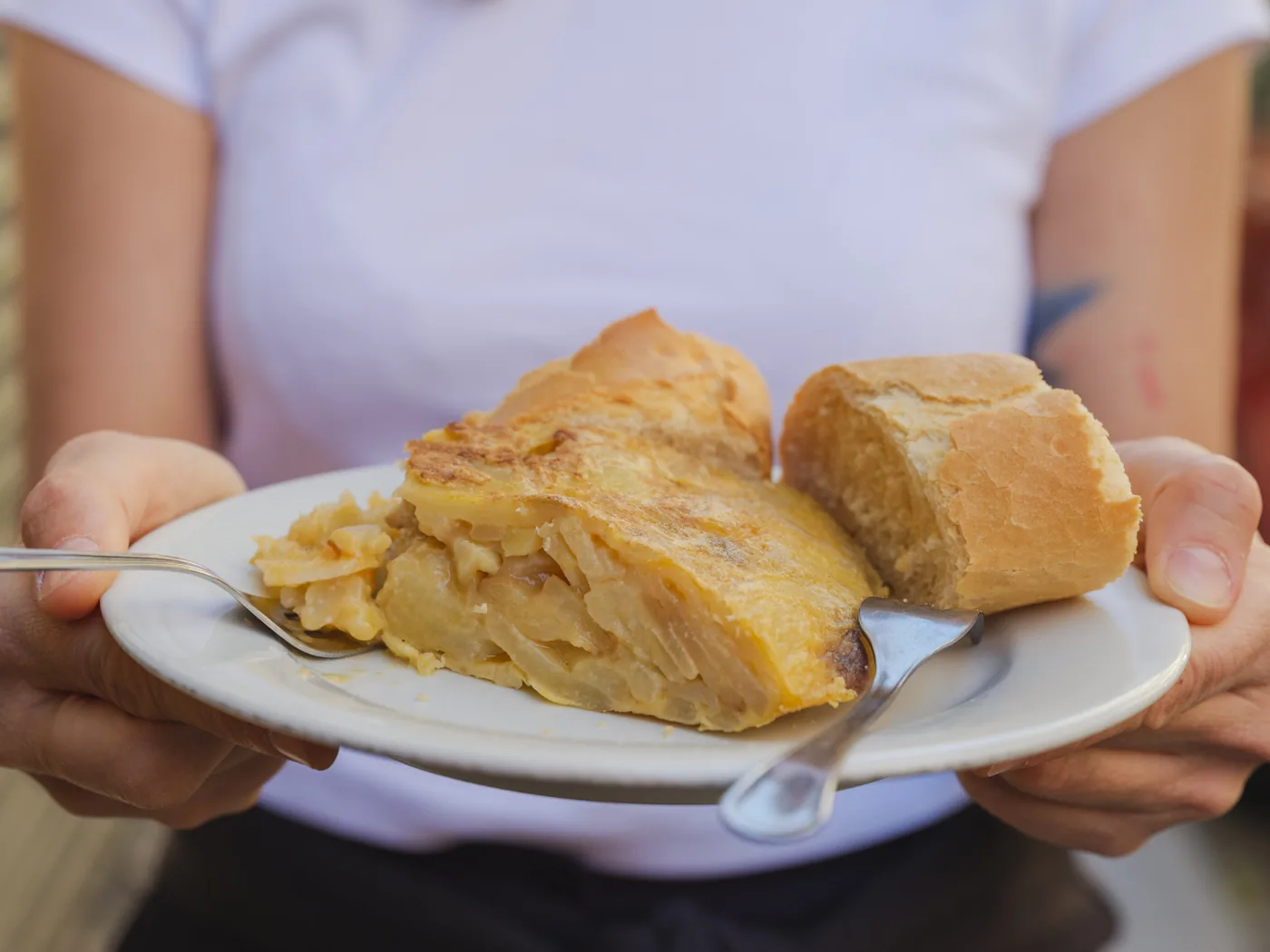
If what you want is to sit down, keep straight: at the end of the street you’ll find plenty of terrazas.
Dinamo tour
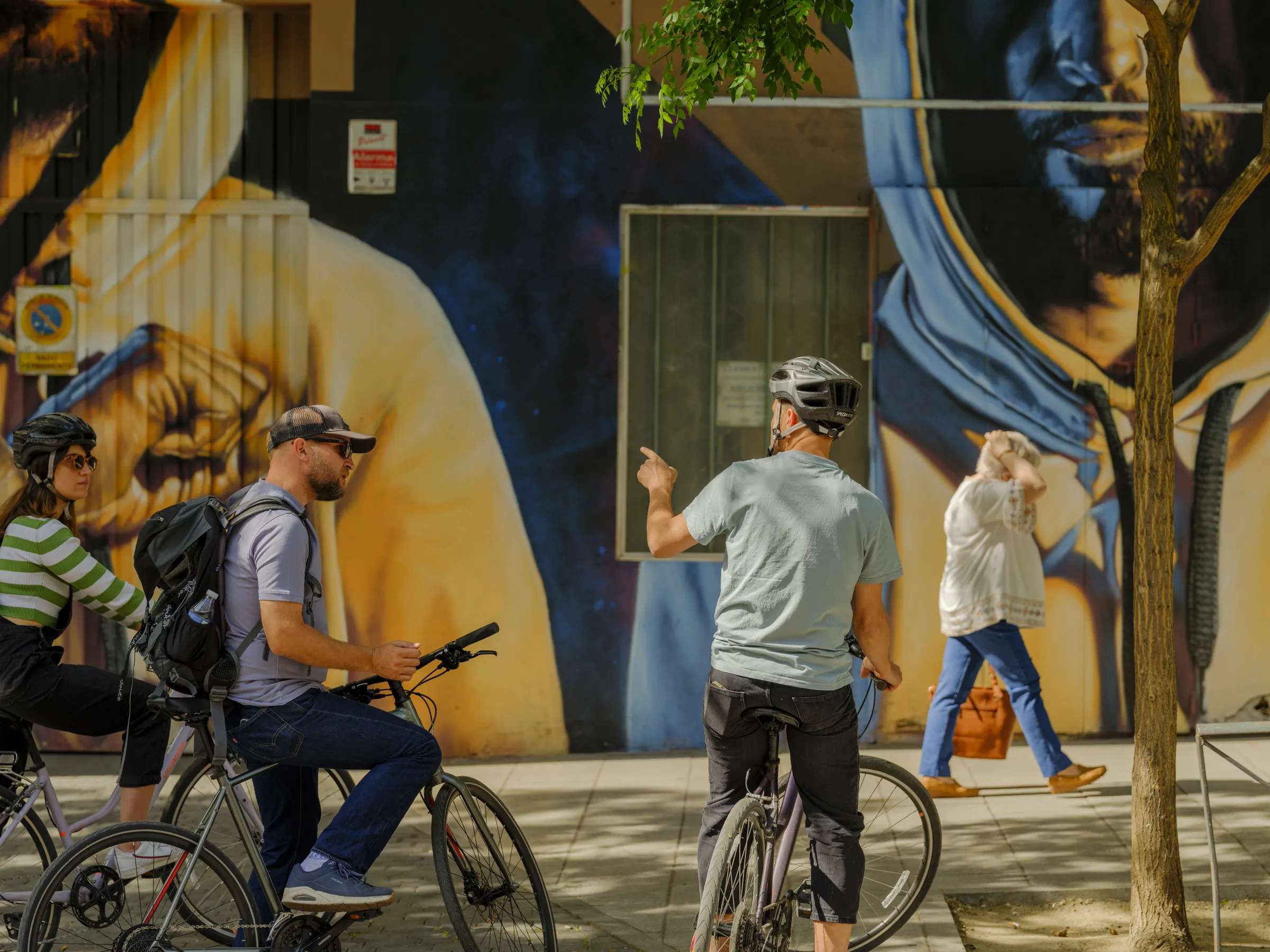
One thing: this Day 1 route — from the Royal Palace to Cava Baja by way of Plaza Mayor — is part of the ground I cover on my bike tour, which also connects most of what’s coming on day 2 and 3: Las Letras, The Prado, the Retiro, the Templo de Debod. Three hours, and you have the whole itinerary mapped in your head – with someone telling what you’re looking at matters, and where to stop for your first caña without getting it wrong. Here’s the link. If you’d rather go on your own, keep reading: the rest of the day is yours.
If you feel like it, next door you have the Museo de los Orígenes — small, free, a twenty-minute visit. It tells how Madrid went from a crossroads to the capital of an empire.
- Hours: Tuesday to Sunday and holidays, 10:00 AM to 8:00 PM
- Summer, 15 June to 15 September: 10:00 AM to 7:00 PM
- Admission: free
- Metro: La Latina (L5) · Tirso de Molina (L1)
Another option, if you’ve arrived in the middle of a heatwave, is the Mercado de la Cebada: a real neighbourhood market without the pretensions of San Miguel. Very local, and friendly with it.
First day done. You’ve seen Habsburg Madrid without entering a museum (one of the big ones, anyway), eaten on the move and dined bar to bar. The rest, tomorrow.
Day 2: Las Letras, the museums and a breather in the Retiro
Today you do enter a museum. One. The classic second-day trap is trying to do the whole Art Triangle — Prado, Thyssen, Reina Sofía — and stumbling out at three in the afternoon, dizzy, having taken in nothing. Each one tells a different story, and two hours are enough to understand one well — not to sprint through three. Getting into a museum takes energy, so first we stop for chocolate con churros at Chocolat Madrid.
- Corner of Calle San José and Calle Santa María, in the heart of the Barrio de las Letras.
- Chocolat Madrid on Google Maps
The same goes for the tapas scene today: bars with mixed personalities, some touristy, some not. The ones I do recommend are marked on the article’s map (layer “Day 2 · Las Letras”) — the five or six where I actually stop.
Open the interactive map on the “Day 2 · Las Letras” layer
There’s a third way to cross that rectangle and it’s the one I use: the Hidden Madrid Bike Tour — three hours, eight riders, stopping wherever it’s worth stopping.
Before choosing a museum, a practical note: the order of Day 2 adapts to wherever you start. The natural way is to begin at the bottom and work up — Reina Sofía, Thyssen if you like, Prado, the Jerónimos church behind the Prado, and finish in the Retiro to rest. The other way round works too, but you end the day at Atocha instead of in a park. If you’re only doing one museum, choose by what you’re after.
How to choose between the Prado, the Thyssen and the Reina Sofía
The three museums of the Art Triangle don’t compete; they complement each other. Each covers a different stretch of European painting: the Prado runs from 1400 to 1850, the Reina Sofía from 1880 to today, and the Thyssen fills the gaps the other two leave. Which one to choose depends on what you want to see.
All three have free-entry time slots, but the queue eats the saving. If you’re only doing one today, buy the ticket online the night before.
The Museo del Prado is the Spanish royal picture gallery. What you see here isn’t a curated collection; it’s what the Habsburgs and the Bourbons collected between the 16th and 19th centuries to hang in their palaces. Velázquez complete — Las Meninas, the royal portraits, The Surrender of Breda. Goya complete — the Majas, the Caprichos, the Black Paintings. Bosch’s The Garden of Earthly Delights, because Felipe II was a fan. Titian, Rubens and the Flemish masters through the Habsburg inheritance. If European painting from 1400 to 1850 is your thing: two or three hours. If what you care about is everything that came after, this isn’t your museum.
- Monday to Saturday: 10:00 AM to 8:00 PM
- Sundays and holidays: 10:00 AM to 7:00 PM
- Free entry: Monday to Saturday, 6:00 PM to 8:00 PM · Sundays and holidays, 5:00 PM to 7:00 PM
- Prado tickets, official site
- Metro: Banco de España (L2) · Estación del Arte (L1)
The Museo Reina Sofía picks up where the Prado ends: late 19th century to today. The star is Picasso’s Guernica — the one many people assume hangs in the Prado; it doesn’t, it’s here, in a room designed for it. Dalí, Miró, the Spanish avant-gardes and international contemporary art. The building is Madrid’s old 18th-century General Hospital, extended by Jean Nouvel in the early 2000s. If the 20th century, Picasso or surrealism is what you’re after, this is your museum.
- Monday and Wednesday to Saturday: 10:00 AM to 9:00 PM
- Sundays: 10:00 AM to 2:30 PM
- Tuesdays: closed
- Free entry: Monday and Wednesday to Saturday, 7:00 PM to 9:00 PM · Sundays, 12:30 PM to 2:30 PM
- Reina Sofía tickets, official site
- Metro: Estación del Arte (L1)
The Museo Thyssen-Bornemisza is the most curious of the three. It’s a private collection sold to the Spanish state in 1993, covering 700 years of European painting across three floors, in chronological order. It fills the gaps the Prado and the Reina Sofía leave: the early Italian Renaissance, the Impressionists (Monet, Van Gogh, Cézanne), the German Expressionists, American pop art. It also holds one of the few Hopper collections in Europe. If you have one morning and want “a bit of everything” at real quality, this is your museum.
- Tuesday to Sunday: 10:00 AM to 7:00 PM
- Saturdays: 10:00 AM to 11:00 PM
- Free entry: Mondays, 12:00 PM to 4:00 PM
- Thyssen tickets, official site
- Metro: Sevilla (L2) · Banco de España (L2) · Estación del Arte (L1)
But remember: today you choose one. You come back to Madrid for the other two.
Breakfast done, the day begins. I’ll describe the route south to north: Reina Sofía first, then the Prado and the Jerónimos, closing in the Retiro. If you start with a different museum, adjust the order.
If you didn’t get to the squid sandwich yesterday, coming out of the Reina Sofía you have Cafetería La Brillante. A terraza on the square, the same sandwich, none of La Campana’s queue. A good place to stop after a few hours on your feet.
If you’re not hungry yet, walk up towards Plaza Santa Ana, the nerve centre of the neighbourhood. It was a project by the architect Silvestre Pérez, driven by José Bonaparte — yes, Napoleon’s brother. The streets on the way have lines from Cervantes and Lope set into the pavement, plaques on the façades marking who lived where, and brass bars that have been there since before the last 19th-century printing house closed.
On the way to the square, look down the side streets. There are neighbourhood cafés, old shops and small restaurants that go unnoticed. If you’ve come as a couple, note one down on the way up. The good places for dinner are here, not on the square itself — the square is for looking, the streets are for eating.
On the square you’ll find one of the oldest theatres in Europe: the Teatro Español. The company has been running since 1583; the current building is from 1807, rebuilt by Juan de Villanueva after the fire of 1802.
Opposite the theatre, on your right, is the Cervecería Alemana. Hemingway spent a lot of time here during the Spanish Civil War (1936–1939). It’s still open and keeps the walls it had then — but don’t stop to eat there, beyond a caña and the obligatory photo.
This is my favourite neighbourhood. But let’s keep going.
At the foot of the barrio, a few hundred metres from the Reina Sofía, you have the CaixaForum and Patrick Blanc’s vertical garden: an entire wall of living plants, twenty-four metres high, no soil in sight. It’s one of the few buildings in the area that stop you in the street. The building was a late-19th-century power station, recovered as a cultural centre by Herzog & de Meuron. The Swiss firm’s signature is the visual trick of the whole thing: the ground floor is cut away, which makes the upper mass seem to float over the void.
If the big museums don’t call to you, or you still haven’t decided, have a look at what’s on at the CaixaForum Madrid. The exhibitions change every few months, they’re usually monographic, and entry is cheap. You’re already at the door.
- Monday to Sunday: 10:00 AM to 8:00 PM
- General admission: €6
- CaixaForum tickets, official site
- Metro: Estación del Arte (L1)
The CaixaForum sits on the Paseo del Prado, which is no ordinary street: it’s the first urban axis Madrid ever designed for itself. Until then, the city was the medieval Madrid you saw yesterday — streets that begin wherever they begin, with no plan. Carlos III decided Madrid needed an enlightened promenade: with science, with art, with botany. The job fell to three royal architects: Sabatini, Ventura Rodríguez and Juan de Villanueva. The idea was to build Madrid as the cultured capital of an empire, not as a sprawl of guilds.
Dinamo tour
If you reach Day 2 with your legs already complaining — because Day 1 was long — here’s an alternative: this same Paseo del Prado–Retiro axis, plus the neighbourhoods that don’t fit into 3 days (Madrid Río, lower La Latina, the whole of the Retiro), I cover by bike in 3 hours. It’s the way to fit two days of Madrid into one morning without giving up the stops. Details below, in case it tempts you.
Opposite the CaixaForum, across the Paseo del Prado, you’ll see the Royal Botanical Garden. We’ll come back to it.
As you climb, stop on Calle Cervantes. There stands the Casa de Lope de Vega, now a museum. Inside, it’s one of the very few homes from Madrid’s 16th and 17th centuries — Spain’s Golden Age — preserved as it was. On the same street, a few metres away, a plaque marks where Cervantes lived and died in 1616. The author of Don Quixote, equivalent in cultural weight to Shakespeare in English. Lope and Cervantes lived and died a few steps from each other, on bad terms to the end.
If you fancy a bite, right next door is Casa González: a lifelong ultramarinos — a traditional grocer’s — with a bar at the back. Wines by the glass, cheeses, tinned delicacies. Small, no reservations, no pretensions.
- Monday to Friday: 10:00 AM to midnight
- Saturday: 10:30 AM to midnight
- Sunday: 11:00 AM to midnight
- Casa González on Google Maps
From Casa González, Plaza Santa Ana is a few metres uphill. If you’ve already been, keep going down towards the Congreso de los Diputados, Spain’s parliament. Opposite the Congreso, next to the Hotel Palace, stands the Plus Ultra building. Its façade holds a small clock with figures that comes to life four times a day: for three minutes, 18 bells ring while five figures from Goya’s era move — Goya himself, the Duchess of Alba with her dog, Carlos III, a Madrid maja and the bullfighter Pedro Romero. Easy to miss if you pass at the wrong moment — so if you arrive just before the hour, wait.
- Daily: 12:00 PM, 3:00 PM, 6:00 PM and 8:00 PM
- Carrillón Plus Ultra on Google Maps
Between the Plus Ultra and the Hotel Palace runs Calle del Duque de Medinaceli. It’s one of the best streets in the neighbourhood for tapas, at midday or at night. Traditional tascas — old-school taverns — paper tablecloths, mixed clientele: this is where some senators and members of parliament stop on their way out of the Congreso.
Now you cross the Paseo del Prado and approach the museum. What you’re walking on was, until the 19th century, part of the Buen Retiro: the royal gardens reached the promenade itself. The area was called “the hill of the sciences”. It sounds pompous, but the name had substance: this is where the Royal Academy of Sciences, the Astronomical Observatory, the Royal Botanical Garden and what was to become a natural history cabinet were concentrated. The Prado building, designed by Juan de Villanueva (the same architect as the Teatro Español), was born as the Royal Academy of Sciences, not as a picture gallery. The paintings came later, when Fernando VII decided to move the royal collection into the building. It’s a detail that changes how you look at it: what is today one of the great museums of the world was born as a temple of the Spanish Enlightenment. Madrid boarded the Industrial Revolution late and badly, but the intellectual ambition is in these stones.
Next to the Prado, showing between the trees, is the Church of the Jerónimos. It goes unnoticed because it sits behind the museum, but it’s one of the most institutionally loaded buildings in the city. This is where the Princes of Asturias swore their oath until the first third of the 19th century — the future monarch acknowledging, before the court, their place in the succession. Entry is free; five minutes inside is enough.
Before entering the Retiro, an optional stop: the Royal Botanical Garden, south of the Prado. Entry costs a few euros. You’ll see plants that Spanish botanists brought back from the Americas and the Philippines from the 18th century onwards.
And with all that, your legs are asking to stop. That’s why the Retiro is where it is: at the end of the Paseo del Prado, a green counterweight to all that concentrated culture. Cross Calle Alfonso XII and another Madrid begins.
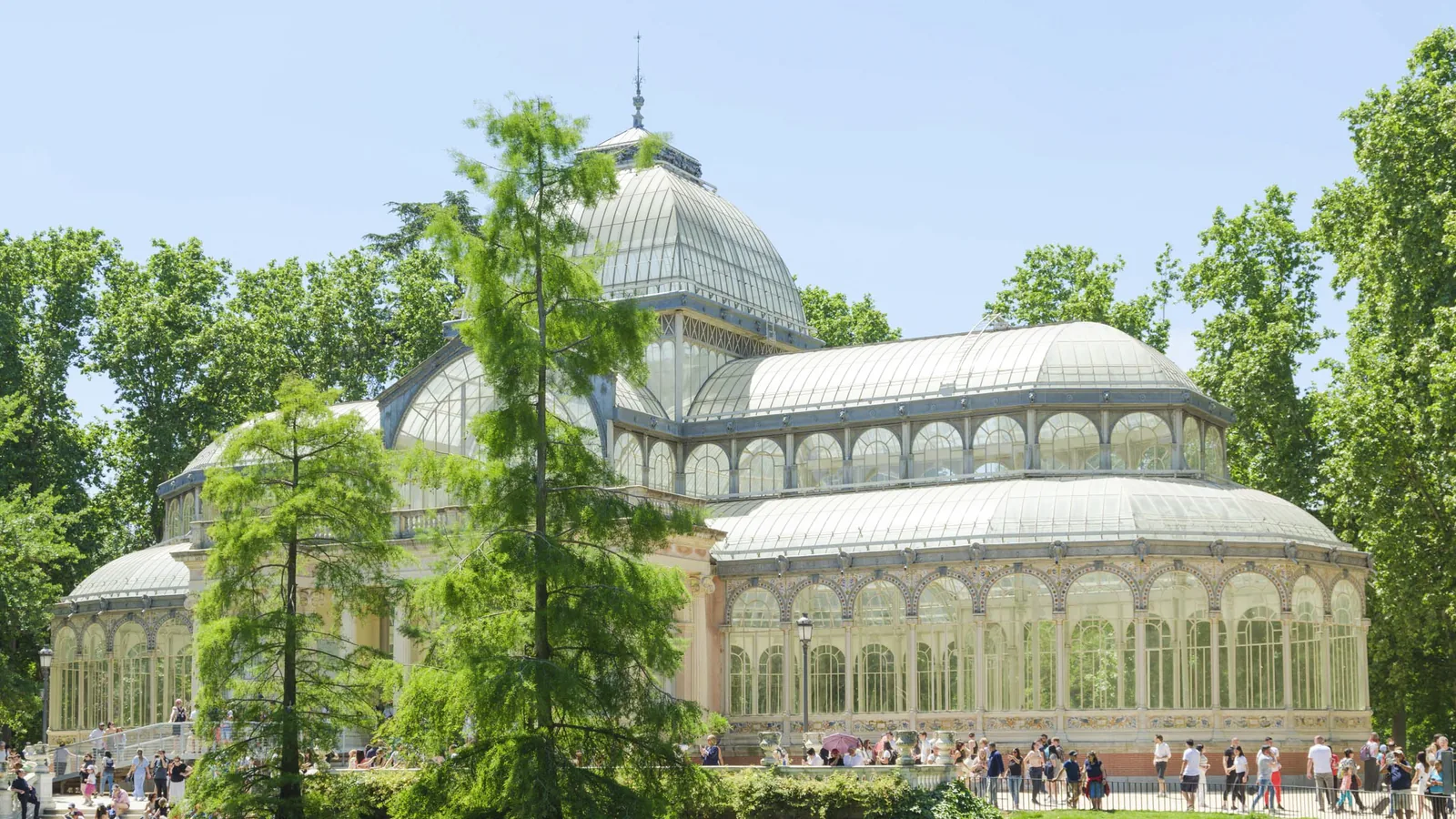
Up there is the Puerta de Felipe IV, one of the entrances to the Retiro. You don’t do the whole Retiro — it’s 125 hectares — and you don’t need to. The stops that count: the French Parterre in the northwest corner, with the ahuehuete at its centre, a Mexican cypress and the oldest tree in Madrid; the Estanque — the boating lake — and the Monument to Alfonso XII, the colonnade over the water where Madrid meets at weekends when the rowing boats are out; the Palacio de Cristal, an iron-and-glass pavilion from the late 19th century built for an exhibition of plants from the Philippines, now hosting the Reina Sofía’s contemporary art shows, free entry; and the Rosaleda, the rose garden at the south of the park, best in May or June with the roses in bloom. You can cross the Retiro in an hour and a bit at an easy pace — stopping, sitting on a bench when you need to.
Leave by the Puerta de Alcalá, the neoclassical arch at the north of the park. The obligatory photo, yes — but also this: cross the street and you’re in another Madrid.
Second day done. You’ve walked the Paseo del Prado, chosen one museum, and rested in the Retiro. Tomorrow, other neighbourhoods.
Day 3: neighbourhoods with personality, and a sunset from up high
The third day slows down. The first two were about walking historic Madrid and understanding enlightened Madrid. Today you go to three neighbourhoods where Madrid is Madrid without having to prove anything — Salamanca, Chueca and Malasaña — and you close the day up high, at the Templo de Debod, watching the sun drop over the city.
One thing before we start: I’m not going to recommend specific places here. Salamanca isn’t my neighbourhood, Chueca isn’t either, and Malasaña changes so fast that whatever I mark today may be gone next year. I’ll tell you what’s there and what to look for; you decide. That’s part of the last day.
Salamanca: the Madrid that doesn’t look like Madrid
Salamanca is the most expensive neighbourhood in the city and the least touristy of the central ones. A perfect 19th-century grid — the work of the Marqués de Salamanca, who bankrupted himself building it and gave the barrio its name — with straight streets, wide pavements and five-storey buildings that look like Paris. There are no listicles to chase here: there are shops, law firms, and the restaurants where the lawyers eat.
If you’ve come with a budget and want to see how white-collar Madrid eats, this is the neighbourhood. If not, the architectural walk is worth half an hour anyway: Calle Serrano, Calle Velázquez and Calle Goya are the three arteries, and they give you the measure of the urban project. It’s the opposite of the medieval Madrid of Day 1.
One stop does deserve a pause: the Jardines del Descubrimiento, behind the Columbus monument. Three blocks of pale concrete, carved with the names of the navigators who crossed the Atlantic with Christopher Columbus in 1492.
Chueca: from seventies Madrid to today’s
Coming down towards the centre from Salamanca, you cross Calle Génova and enter Chueca. It has been Madrid’s gay neighbourhood since the seventies, it still is, and over the last two decades it has gentrified into design shops, cocktail bars and contemporary kitchens. The transformation is part of its history, not something to hide.
The centre of it is Plaza de Chueca and Calle Augusto Figueroa. But the best way to see the barrio isn’t the square — it’s wandering the streets around it: Hortaleza, Pelayo, Barbieri. That’s where the small shops are, the neighbourhood cafés, and the bars that were open before the gentrification.
A mention for the Mercado de San Antón, because plenty of readers will go looking for it. Honesty: it’s a market rebuilt as a gourmet space with a rooftop terraza. The building was redone for that purpose; it isn’t a traditional market. The rooftop works for a caña in the sun with views; the first-floor stalls are expensive for what they offer. If you want a real market, you were near La Cebada in La Latina on day one. This one I’d skip.
Malasaña: Madrid without filters
Cross Calle Fuencarral — the pedestrian street that separates Chueca and Malasaña — and you’re in another neighbourhood. Malasaña is the barrio of the Movida, Madrid’s eighties counterculture explosion; today it’s speciality coffee, vinyl shops, bookshops and small bars. It’s the youngest neighbourhood in the centre and the one that changes fastest. What’s there today may be gone next year.
The nerve centre is Plaza Dos de Mayo — small, a statue in the middle, bars on every side. The streets that count are Calle del Pez and Calle Espíritu Santo: that’s where everything is happening in shops, cafés and small bars. There’s little point marking specific stops, because it all turns over quickly. Walk without a plan, and watch for whatever has a queue of locals.
One exception that does deserve a stop: Plaza de San Ildefonso, between Fuencarral and Hortaleza. Small, with café tables outside, it’s one of the few corners of Malasaña where you can sit down without losing the street. If you need to eat, the same rule as Plaza Mayor and Plaza Santa Ana applies — the squares (Dos de Mayo has gone touristy these past years) are for looking, the side streets are for eating. San Ildefonso is the exception: that one is for sitting.
Templo de Debod: the sunset
From Malasaña, walking west, you’re at the Parque del Oeste and the Templo de Debod in fifteen minutes. If your legs say no, take a taxi: eight to ten euros, ten minutes.
The Templo de Debod is an Egyptian temple from the 2nd century BC that Spain received in the sixties — a gift from the Egyptian government for Spain’s help in the Abu Simbel rescue operation. It stands, rebuilt stone by stone, at the top of the Parque del Oeste, facing west, and the sunset from there is among the best in the city.
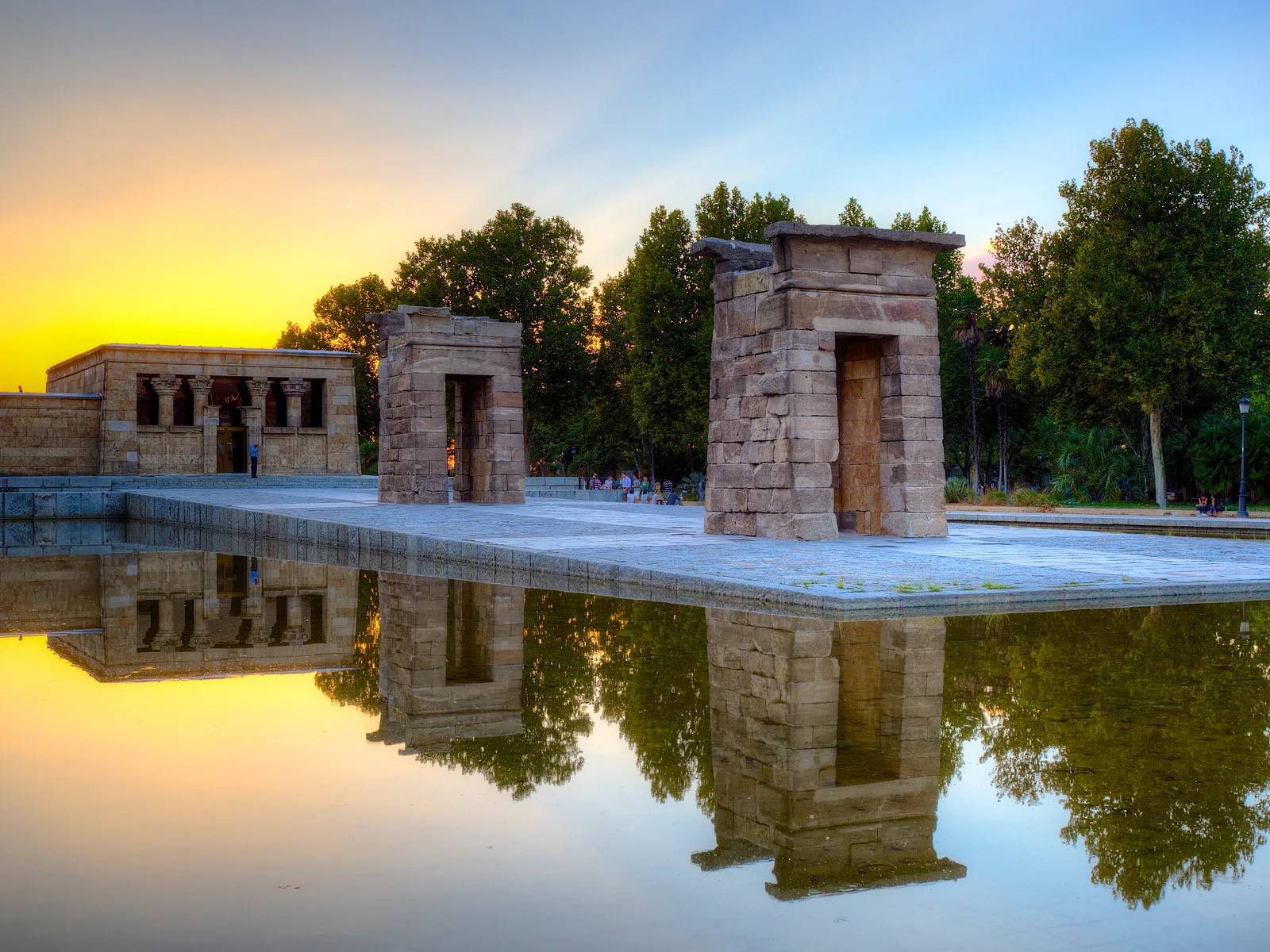
The catch: everyone knows it. Arrive thirty minutes before sundown — in summer that can be as late as 9:30 PM; in winter, before 6:00 PM. If you go in summer, walk down the slope first, find a spot on the grass, and climb back up as the light starts to fall. What doesn’t work: arriving ten minutes early and expecting a front-row spot.
Madrid in 3 days: frequently asked questions
Is 3 days enough to see Madrid?
Yes — if you accept you won’t see everything. What you can see in Madrid in 3 days: the historic centre on foot, one museum on the Paseo del Prado done properly, three or four neighbourhoods with personality, and good food along the way. What doesn’t fit: day trips to Toledo or Segovia, El Escorial, or more than one big museum.
What’s the best time of year to visit Madrid in 3 days?
March to June and September to October. Kind temperatures, long daylight and terrazas working as they should. July and August are doable, but the heat (35–40 °C is normal) forces you to reorganise the itinerary and keep the central hours for museums or shade. November to February works if dry cold doesn’t put you off: a city without queues, and a winter light that museums are made for.
Which museum should I choose if I only have time for one?
If European painting from 1400 to 1850 is your thing (Velázquez, Goya, Bosch): the Prado. For the 20th century, Picasso and surrealism: the Reina Sofía. For a bit of everything at high quality: the Thyssen. On getting in: all three have free time slots, but in high season that can mean a 1–2 hour queue and racing through the museum against closing time. If this is your one visit to Madrid for a long while, pay for the ticket and buy it online the night before. Some works ask for more than a sprint.
Is the Royal Palace worth going into?
It depends. If you haven’t seen Europe’s royal palaces (Versailles, Schönbrunn), yes: a two-hour visit and you come out understanding the scale of the Spanish Empire. If you already know the format, the Campo del Moro gardens are free, have better views and fewer people.
Is Madrid a walkable city?
Very. The historic centre fits inside a rectangle of roughly 3 km by 2.5 km. Royal Palace to the Retiro is 35 minutes on foot; Gran Vía to Puerta de Toledo, 25. Most of the central monuments sit inside that rectangle. The metro is useful when it’s hot — above all on the modern lines with air conditioning, which is not all of them — or when you’re going far from the centre; over short distances you’re almost always faster walking. And to widen your radius inside the centre without breaking sweat — connecting areas that feel far apart on foot (Retiro ↔ Madrid Río, for example) — a bike solves it better than any travel pass.
How do I get to the centre from Barajas airport?
Four options, depending on budget and comfort (fares checked August 2026). The cheapest: the C1 Cercanías train from T4 — it doesn’t stop at T1/T2/T3, and it now runs only as far as Chamartín — €1.70. The metro’s L8 runs from every terminal and comes to roughly €4.50–5 with the €3 airport supplement already included. The most direct by public transport: the 24-hour Airport Express bus to Cibeles or Atocha (€5, flat fare) — at night it stops at Cibeles and does not reach Atocha. The most comfortable, door to door: an official taxi at a fixed €33 fare inside the M-30 ring road. Uber/Cabify/Bolt: variable pricing by hour and demand, no public fixed fare.
One important warning: inside the terminals, don’t accept offers from anyone approaching with a “taxi” or a transfer to the centre. They charge far above the €33 and they’re not official taxis. Legal taxis are taken only at the outdoor rank, fixed fare of €33 inside the M-30. Ride-hailing apps (Uber, Cabify, Bolt) are fine only if you booked through the app yourself and the plate and driver match the booking.
Is a guided tour worth it?
If you’re coming for three days and it’s your first time, yes — and on the first day, not the last. You arrive with the mental map already made, and you get double out of the other two days.
On foot or by bike? On foot you move slower and the neighbourhood stays with you. By bike you cover twice the ground and connect areas you’d never link up walking — the Retiro and Madrid Río in one afternoon. In spring and autumn both work; it comes down to how you like to travel.
Summer changes the maths. Between 2:00 PM and 6:00 PM the granite soaks up sun all morning and hands it back like an oven, and crossing that on foot isn’t visiting, it’s surviving. On a bike those same hours behave differently: you make your own breeze, you ride in shade wherever there is shade, and you stop where there’s water. It’s the one way I know to use the middle of a Madrid afternoon in August instead of writing it off.
Madrid in 3 days: what you take home
If you’ve followed this 3-day Madrid itinerary — or adapted it, which is the same thing — you’ve walked some 20 kilometres. You’ve seen Habsburg Madrid, enlightened Madrid, and the Madrid that reinvents itself every five years. You’ve done one museum well and seen two from the outside. You’ve dined bar to bar, eaten sitting down at least once, and waited for the sunset with the rest of the city. You haven’t seen everything. Nobody does. But you’ve understood how the city works — and that’s the one thing that counts when you come back.
If you’d like to do this route without thinking about maps, with someone who knows the pauses, the stories and the shortcuts, you can close the first of the three days with me. Yes — these are the only links I’ll allow myself. But I did warn you.
Three days in Madrid aren’t “seeing Madrid”. They’re beginning to understand it. And there’s only one method for that: walk it, cycle it, stop when something catches your eye, and come back the next day to see if it’s still there. This is how I travel — slow, at street level, no shortcuts and no affiliates telling you where to go or what to do. It works here. It will work anywhere you choose to go that way.