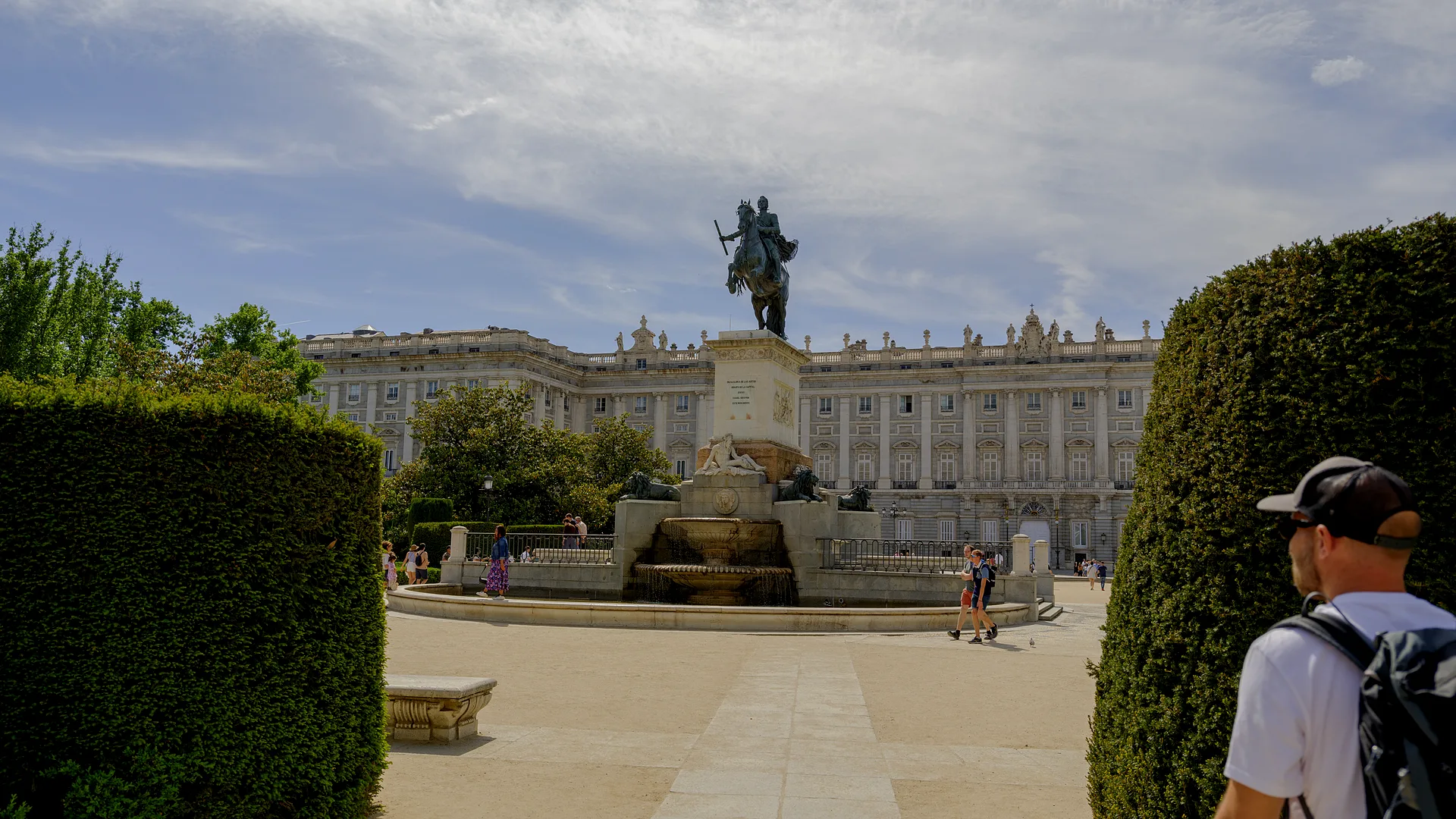
Yves looking out over Plaza de Oriente toward the Royal Palace of Madrid on a Historic Madrid Walking Tour
HISTORIC MADRID · WALKING

The Madrid walking tour built on the city's Arab foundations.

Eight walkers, never a crowd — two and a half hours in English, every morning at 9:30./span>

★ 4.9 on Google · 26 reviews

Free cancellation up to 24 h before

Duration
2.5 h
Daily · 9:30
Group
8 Guests
no more
level
Easy
near flat
Price
€42
per person
languages
EN
ALWAYS
HOW IT ACTUALLY WORKS

Four stages, from booking to the map I send after.

Madrid is the only European capital founded by Arabs — Mayrit, late 9th century, and the Arab wall is still there in limestone below the Almudena. Every street stacks an Arab layer, a medieval Christian one, a Habsburg one, a 19th-century one — and a walking tour done properly reads those layers, on foot, before eleven, while the light still comes sideways. We start at 9:30 in Bourbon Madrid around the Teatro Real, drop into the Arab and Christian wall on Cuesta de la Vega, cross medieval Madrid de los Austrias, reach Habsburg Madrid at Plaza Mayor, go down through La Latina and Cava Baja, and finish at El Rastro. Ten stops, eight walkers max, never folded in with another group — so you can actually look up.

01 · THE SETUP

1 minute

Book online, pick format and time. You’ll get confirmation and meeting point by email — no phone calls unless you’d like one.

02 · THE MEETING

10 minutes

I’ll be waiting at Opera metro station, exit by the taxi rank, with a Dinamo sign. Water bottle for each of you, a quick intro to the morning, and we set off.

03 · THE ROUTE

2.5 hours

A route I built corner by corner — paced so questions get answered before the next plaza.

04 · the local map

5 minutes + email

Before we say goodbye, a verbal map of where to eat, drink and walk. Same map in writing in your inbox the same afternoon.

Total: 2.5 h on the day, plus a follow-up email.

THE TOUR

A walking tour of Madrid, layer by layer.

Madrid is the only European capital founded by Arabs — Mayrit, late 9th century, and the Arab wall is still there in limestone below the Almudena. Every street stacks an Arab layer, a medieval Christian one, a Habsburg one, a 19th-century one — and a walking tour done properly reads them in build order, on foot, before eleven, while the light still comes sideways.

We start at 9:30 in Bourbon Madrid around the Teatro Real, drop into the Arab and Christian wall on Cuesta de la Vega, cross medieval Madrid de los Austrias, reach Habsburg Madrid at Plaza Mayor, go down through La Latina and Cava Baja, and finish at El Rastro. Ten stops in build order, eight walkers max, never folded in with another group — so you can actually look up.

Madrid read in order — even when the streets aren’t. Eight walkers. One morning.

THE ROUTE

Ten stops on foot. The eleventh layer is what's between them.

Ten stops you’d find in any Madrid walking tour worth its salt — Royal Palace, Plaza Mayor, El Rastro, the rest. What you won’t find is the order I tell them in, which follows the centuries Madrid was built across, not the order a guidebook prints. The streets between are mine.

Officially Plaza de Isabel II — but locals call it Plaza de la Ópera, after the Teatro Real Madrid whose back facade frames the square. Eighteenth century there was an earlier theatre here, the Caños del Peral. When they dug the metro, they found what was underneath: the Caños del Peral fountain, the city’s old water channels, a stretch of the Amaniel aqueduct. You can visit them for free inside the Opera metro station. Most people don’t know they’re there. We meet here at 9:30 sharp. I’ll have a Dinamo sign by the taxi rank.

Teatro Real facade in Plaza de Oriente, Madrid—the opera house's neoclassical front under blue sky, the meeting point of the Historic Madrid walking tour.

The Royal Palace Madrid sits on the hill where the tenth-century Arab fortress once stood — the actual Mayrit. Felipe V built it after the medieval Alcázar burned on Christmas Eve 1734. The largest royal palace in Western Europe: 3 418 rooms, twice the footprint of Versailles. No king lives there now. The twenty stone kings lining Plaza de Oriente were carved to crown the palace cornice — when the king saw the weight, he ordered them down to street level. In the middle, Felipe IV on his rearing horse, sculpted by Pietro Tacca with Galileo’s maths to keep him balanced on two hooves.

Temple of Debod at sunset reflected on its pond, Hidden Madrid bike tour viewpoint stop.

Calle del Factor curves up one floor above Bailén, paved in stone, ending in a balcony that drops sharply over a terrace. From there: a clean view of the Almudena Cathedral Madrid and a corner of the Royal Palace, framed by Fernandine streetlamps. The street is named for Fernán López de Ocampo — the Factor of Felipe II, the king’s tax collector and accountant. Underneath, the Arab wall of ninth-century Mayrit still runs: the calle bends because the wall did. The archaeologists found what’s left of it under the buildings.

Golden-hour view of the Almudena Cathedral in Madrid from the viewpoint, a stop on the Hidden Madrid bike tour

Iglesia San Nicolás Madrid is the oldest surviving church in town — listed in the Fuero of 1202 as one of the ten medieval parishes. Its bell tower is twelfth-century Mudéjar — blind horseshoe arches in brick, Christian church masonry in Moorish form. The apse is fifteenth-century Gothic. The nave roof is sixteenth-century Mudéjar wood. The body is seventeenth-century Madrid Baroque. The portico is eighteenth century. Five centuries stacked in one building. Juan de Herrera, who built El Escorial for Felipe II, was buried here first.

Iglesia de San Nicolás de los Servitas in Madrid—the city's oldest church with its Mudejar brick bell tower against blue sky, a key stop on the Historic Madrid walking tour.

Three medieval houses around an admiral in bronze. Plaza de la Villa Madrid was the city’s civic centre until the town hall moved to Cibeles in 2007. The Casa de la Villa is by Juan Gómez de Mora, the architect who also drew Plaza Mayor. Across the street, the Casa de Cisneros — Plateresque, sixteenth-century, built by the cardinal’s nephew — connects to the old town hall by a private arch one floor up. Most cities put their power buildings next to each other. Madrid built a bridge between them. In the middle, Álvaro de Bazán in bronze, the sixteenth-century Spanish admiral who was never defeated in combat.

Casa de la Villa at Plaza de la Villa, Madrid — a stop on the Historic Madrid walking tour

The calle de Segovia drops down what used to be the bed of the San Pedro stream — the natural cleft of the medieval town. The Viaducto de Segovia Madrid crosses it twenty-five metres up, carrying calle Bailén between the Royal Palace and San Francisco el Grande. Three viaducts have stood here: iron by Eugenio Barrón in 1874, concrete in 1934, rationalist rebuild in 1978. For decades it was known as the suicide bridge — the transparent screens went up in the late 1990s. Below, the Casa del Pastor still carries Madrid’s oldest stone coat of arms on its facade.

Historic engraving of Madrid's Alcázar Real and Puente de Segovia—the old royal bridge crossing the Manzanares, a heritage view on the Historic Madrid walking tour.

Before there was a Plaza Mayor, there was Plaza de la Paja Madrid — the medieval town’s main market square, sloping and irregular because nobody planned it. The name comes from the straw sold here, taxed by the church: a percentage went to the canons of San Andrés to feed their mules. Around the plaza, three layers still stand: the sixteenth-century Capilla del Obispo, built to hold the original tomb of San Isidro Labrador — Madrid’s patron saint, who worked the fields for the Vargas family next door. Their renaissance palace is across the square. At the lower end, behind a wall, the eighteenth-century Jardín del Príncipe de Anglona.

Quiet corner of Plaza de la Paja in old Madrid—a bare tree and pastel facades framing the medieval square, an atmospheric stop on the Historic Madrid walking tour.

Cava Baja Madrid is three hundred metres of bars and tabernas — one of the densest stretches in Spain. The street exists because it used to be a ditch: cava means moat. It ran outside Madrid’s second wall, with underground tunnels that let people slip past the gates. By the seventeenth century the wall was gone and Cava Baja filled with inns for the muleteers coming in from Castile. The names survive on the restaurants now: Posada de la Villa, Casa Lucio. Round the corner, the Mercado de la Cebada — a fifteenth-century barley market named for the grain sold here to feed the king’s horses.

Inside Mercado de la Cebada in Madrid—wide light-filled aisles with food stalls and shoppers, a working neighborhood market visited on the Historic Madrid walking tour.

Lavapiés was Madrid’s working-class quarter, now its most multicultural neighbourhood — over eighty nationalities packed into corralas, the eighteenth- and nineteenth-century inner-courtyard tenements built for workers. Down the slope, El Rastro Madrid — the open-air flea market that has run every Sunday for four hundred years. The name comes from the sixteenth-century slaughterhouse up the hill: cattle were carried down to the leather tanneries on Ribera de Curtidores, leaving a trail — a rastro — of blood on the cobbles. The street kept the name. The market grew over it.

Sunday crowd at El Rastro flea market in Madrid—a dense stream of people walking down Ribera de Curtidores, the iconic Sunday stop on the Historic Madrid walking tour.

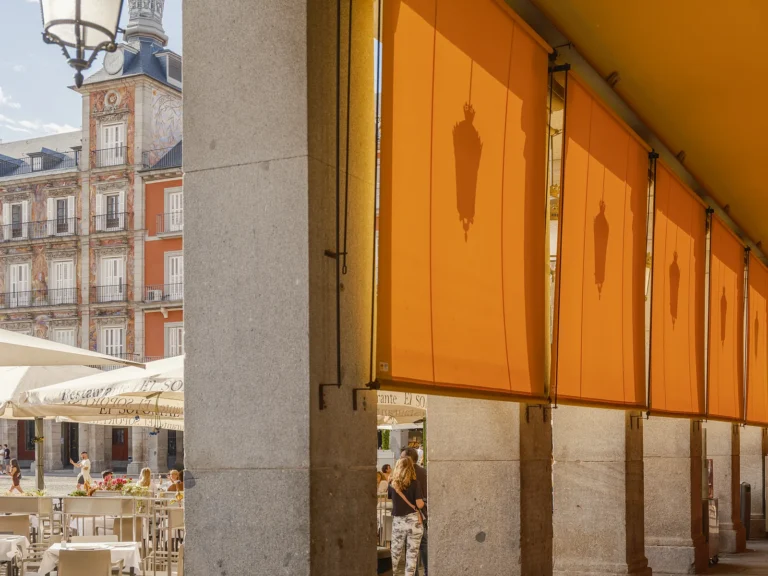
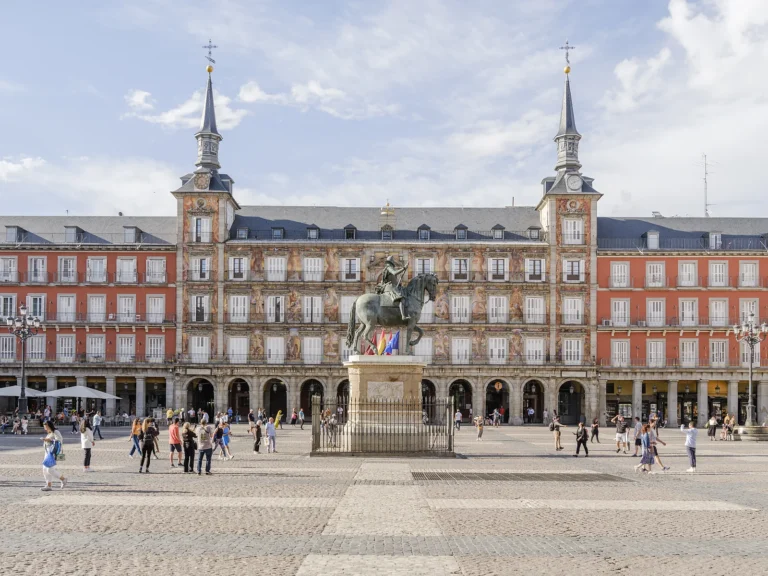
Plaza Mayor Madrid is the centre of Habsburg Madrid — Juan Gómez de Mora’s redesign of the old Plaza del Arrabal, commissioned by Felipe III and inaugurated in 1620. Three fires in 1593, 1672, and 1790 took it down. Villanueva rebuilt the last one, lowered the houses, closed the corners, and drew the monumental arches we walk through now. The bronze Felipe III in the middle was begun by Giambologna and finished by Pietro Tacca, sent here in 1616 as a gift from the Grand Duke of Florence. For three centuries the plaza was Madrid’s public stage: coronations, bullfights, beatifications, and the Autos de Fe of the Inquisition.

Equestrian statue of Felipe III in Plaza Mayor, Madrid—the bronze monument framed by the square's red facades and balconies, a centerpiece of the Historic Madrid walking tour.

Eight walkers. Ten stops. One descent.

WHAT YOU GET · WHAT TO BRING

The kit, the shoes, the small print of your walking tour.

historic-madrid-walking-tour-lavapies-street-perspective

What I bring

What to bring

I keep the kit light so you can travel light too.

New on foot. Not new in Madrid.

The route is new. The guide isn't — and neither is the standard.

I’ve been guiding Madrid long enough to know what makes a morning worth your time. This route is new on paper, but the work behind it isn’t — I’ve walked it, rewalked it, and cut the parts that didn’t earn their place. You’re not the test run. You’re the reason I built it.

Reviews from my bike tours. Same Madrid, same eye, same eight-people rule.

Hi!! I did the tour with 5 friends and we had a blast. The guide was super nice, explaining all of Habsburg Madrid (“Madrid de los Austrias”) with the most curious anecdotes, and honestly he had incredible patience adapting to our pace and a thousand stops. We had our doubts about lasting 3 hours straight, but it turns out super enjoyable and fun — just go comfortable and bring sunglasses!! I’d honestly recommend it to everyone, a new way to discover your own city!!!

— Patricia

VERIFIED GOOGLE REVIEW<br>
translated from Spanish

“I have to say it was a unique experience. It wasn’t my first time visiting Madrid, and the idea of taking this Tour was great. I saw corners of Madrid I’d never seen before and learned stories about this city that I didn’t know. I thoroughly enjoyed the city thanks to Yves, a guide with great knowledge of the city and a real eagerness to make our visit pleasant. I’ll be back. Thank you Yves.”

— Alicia

VERIFIED GOOGLE REVIEW
translated from Spanish  

“Wonderful. I encourage you to try this experience, it’s incredible.. The service, unbeatable, and professionalism unsurpassable. I recommend it!!!”

— Belén

VERIFIED GOOGLE REVIEW
translated from Spanish

These are three of 26. The rest live on Google →

BEFORE THE CITY WAKES UP — PICK A DATE

Eight spots a day. Pick yours.

Live availability below — you book direct, with me, no middlemen.

Secure payment. Instant confirmation.

Powered by Stripe - black
GOOD TO KNOW

The questions, before you ask them.

€42 per person buys two and a half hours on foot through historic Madrid, eight walkers maximum, and a route I designed and guide myself from start to finish — water, liability insurance, and a written local map I send the same afternoon, all included. The price reflects the group size: you’re one of eight, not one of forty, and never folded into someone else’s tour.

No. A free tour walks a fixed route with whoever turns up, and runs on tips at the end. This is a small group — capped at eight — with a flat price, settled when you book. You get a guide who’s accountable for the whole morning, and nothing to weigh up at the door.

Easy. The whole point is to walk slowly through the seams of the city, not to cover ground. Two and a half hours, plenty of stops, plenty of shade, plenty of café options if you need to sit for a minute. If you can walk at a relaxed pace for that long with breaks, you’re set. Eight walkers max means I can adjust the pace to the group, not the other way around.

The guide (me), the route I designed myself, a water bottle, and the follow-up local map I send by email after the tour. Two and a half hours on foot, 9:30 sharp, eight walkers max. No headsets, no folded-in groups, no hidden extras.

Walking shoes that won’t blister, water, and clothing for the season. Madrid summers are hot — bring a hat and sunscreen. Winters are crisp — bring a layer. Nothing special; just don’t show up in heels.

Open tours run in English. Private tours, you pick — English, French, or Spanish. I grew up between Madrid, Algiers, and Casablanca, so the three feel native.

Light rain, we walk. Madrid rain rarely lasts long, and the route has plenty of arcades and barrio bars to wait it out under cover. If the weather turns truly bad — storm, ice, anything unsafe — I reschedule or refund minus the payment processing fee (the card processor charges that up front and doesn’t refund it to me). You’ll hear from me before the tour starts.

Free cancellation up to 24 hours before the tour starts — full refund minus the payment processing fee. (The card processor charges that fee when you book and doesn’t refund it to me when you cancel — usually 2-3% of the booking total.) Less than 24 hours before the tour, and no-shows, no refund.

Didn’t see your question? Just message me — I usually reply within 12 h — usually sooner.

READY WHEN YOU ARE

Madrid in order, not in highlights.

Pick the morning you’re free. I’ll have the route mapped, water bottles ready, and a Dinamo sign at the Opera metro exit before you arrive. Spring and autumn weekends fill first, so a few days’ notice helps.

— Yves

Free cancellation up to 24 h · Yves on the day · Max 8 walkers · Replies within 12 h — usually sooner.

★★★★★ 4.9 Google