
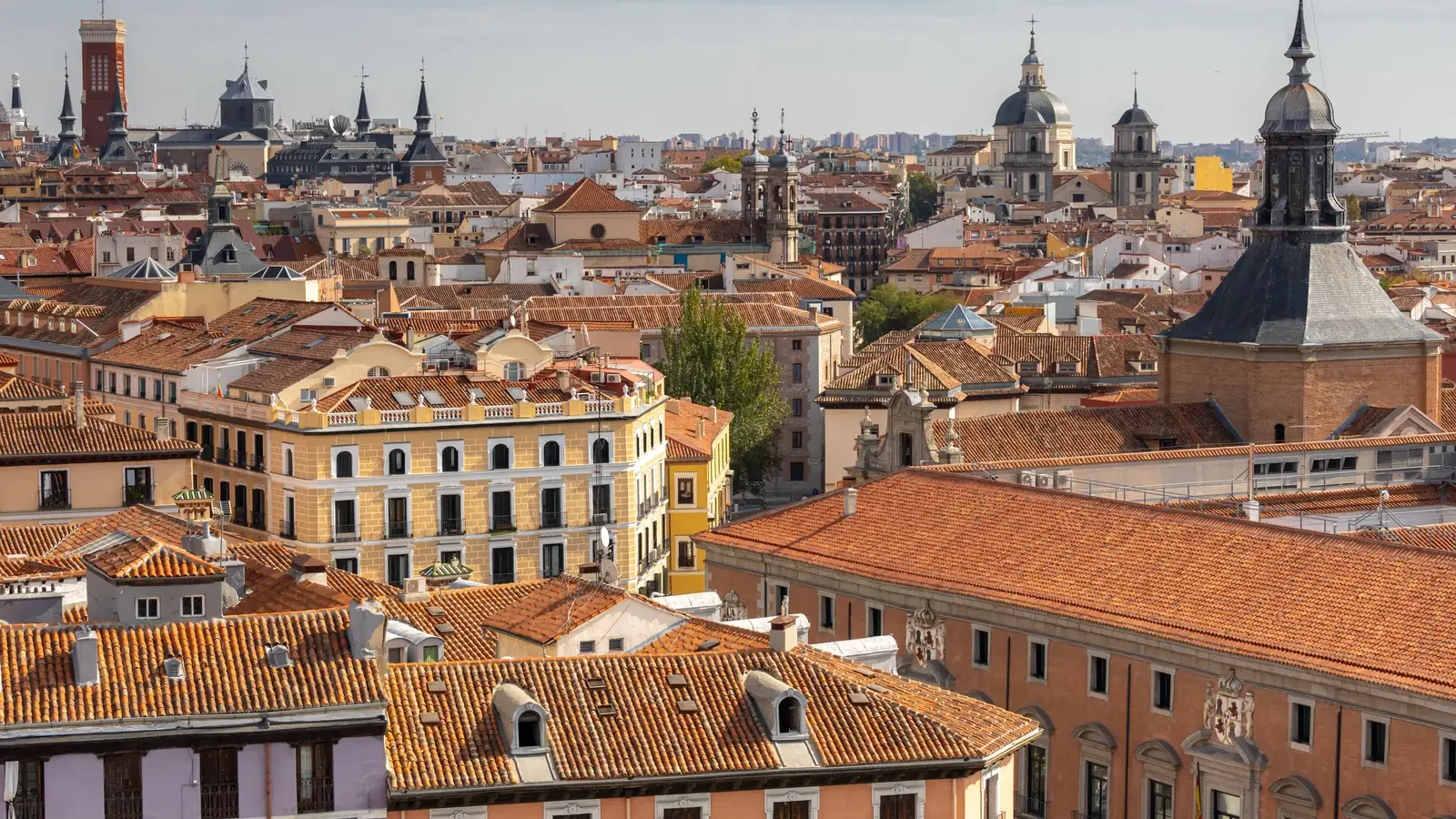
Where to stay in Madrid is a simpler question than it looks, because Madrid is big but compact. If money is no object, almost any neighbourhood in the centre will work for you and this article won’t save you much. If it is, the choice matters more than it seems — and nobody explains it to you honestly.
Every neighbourhood has its own character, and the architecture tells you before anyone opens their mouth: the incomes that lived there decided it a century ago, and it still holds true. It happens all over Europe; it happens here too. What they all share: in 15 minutes, if you know how to cut through the streets, you go from the old taverns of La Latina to the design shops and galleries of Chueca. By bike, those 15 minutes are 5.
In this article I go through the six neighbourhoods that get all the attention, and I name a couple that go unnoticed and deserve a chance — if what you want is to live the neighbourhood, not photograph it.
One thing before we start: there is no single “best neighbourhood”. There is the one that fits the way you travel and what you want to spend. And one more: there are no links to any booking platform here. No commission on your accommodation either. I tell you which neighbourhood to choose; you book wherever you like.
How to choose your neighbourhood
When you book a trip, you choose the neighbourhood by the price of the room and the stars on the platform you book with. What neither the price, nor the stars, nor the description will ever fully tell you is whether you will be able to sleep — whether there is a bar open at two in the morning under your window. The platforms don’t know the neighbourhoods. I do. This article assumes you book on the usual platforms and that you’d rather sleep in a flat on a real street than in a hotel room — if your plan is a four-star with a concierge, the criteria change and this is not your article.
From there, every neighbourhood in this guide is measured on three scales: noise, price and local knowledge. Here are all three.
First scale: noise
Madrid publishes official noise maps every five years — Brussels requires it — and the latest ones are from 2021, before the tourism boom. So when I call a neighbourhood noisy, it’s not because of the data: it’s from crossing these streets every morning by bike and cycling home from dinner at two in the morning (when I’m lucky). Although one piece of data I will give you: when the city council names its zones of high night-time noise pollution, it names four — Malasaña, Chueca, the cavas of La Latina, and the area around Plaza de Santa Ana. Keep that list: it comes back further down.
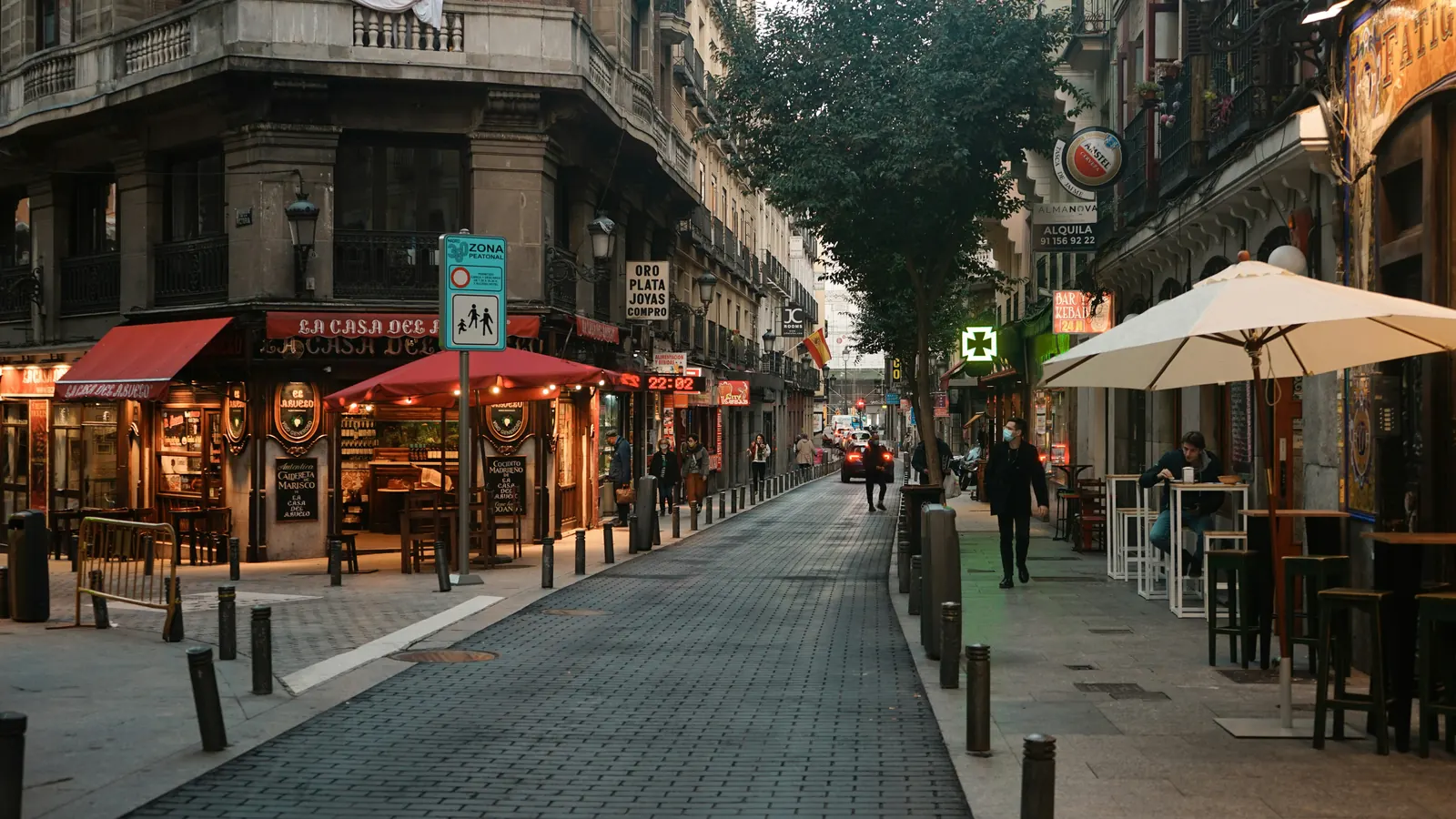
Here’s the nuance almost nobody explains: some neighbourhoods are famous for being noisy because of their bars and restaurants, but that reputation doesn’t belong to the whole neighbourhood — it belongs to three or four specific streets. Two blocks from the hot zone, the same neighbourhood is a different place.
And if you land right in the hot zone but your flat faces an interior courtyard, you’ll sleep like a log anyway. When you book, look at where in the neighbourhood the flat sits and what the window faces, not just which neighbourhood it’s in.
A trick to check before you commit: on Google Maps, look up the bars and restaurants near the flat and check the “popular times” graph. If the bar on your street shows up packed at one in the morning on a Saturday, you already know what’s waiting under your balcony.
That’s why you won’t see decibels in each neighbourhood’s summary: you’ll see a “noise and atmosphere” line that describes the night — what kind of nightlife there is, where it concentrates and how long it lasts. More useful than a number.
Second scale: price
The € scales you’ll see for each neighbourhood are not my impression: they’re built by crossing the average household income the INE (Spain’s national statistics institute) publishes neighbourhood by neighbourhood (income atlas, 2023 data) with the price per square metre, for sale and rent, from idealista’s public price reports (2026). It’s residential data, not tourist data — but a neighbourhood that’s expensive to live in is expensive to sleep in, and at least you know where every € comes from.
Third scale: local knowledge
The third one isn’t in any report: twelve years crossing these neighbourhoods by bike, daily and at all hours. It’s the scale that fills in the “yes, if…” and “no, if…” of every summary — the things that show up neither on the noise map nor in the square metre: which street goes quiet two blocks in, which square is a different place at nine in the morning. And when the data and the street disagree, I’ll tell you — and I’ll tell you which one I trust.
Three questions before you book
- Do you want to walk out of your door straight into the old town?
- Do you want to sleep without noise?
- Do you want to live the neighbourhood, not just sleep in it?
You’ll rarely answer yes to all three. The first two clash more often than you’d think, and the third depends on what you mean by “neighbourhood”. This article helps you decide what to prioritise.
The old town neighbourhoods: the city that built itself
The first four neighbourhoods share a birth certificate — a much older one than the rest, and with no architect. From 1625, Madrid lived enclosed inside Philip IV’s wall, the cerca — a fence of brick and earth that defended nothing: it existed to charge taxes at the gates and keep an eye on who came in. Thirteen kilometres of wall around 500 hectares, more than two centuries of growing inwards: the city squeezed itself tight, and the streets narrowed and curved because they were traced by use — by habit, not by an engineer.
When the wall came down in 1868, the city’s planned expansion was already drawn; the old town, though, stayed as it was. It still is.
That explains how you should walk these four: on foot or by bike, without a list, letting the corner decide. And it explains their bill, which honesty obliges me to hand you: three of the four — Malasaña, Chueca and the cavas of La Latina — are on the city’s official noise list. That’s the price of life still happening in the street. You already know the remedy: two blocks away, or an interior courtyard.
La Latina: where the city began
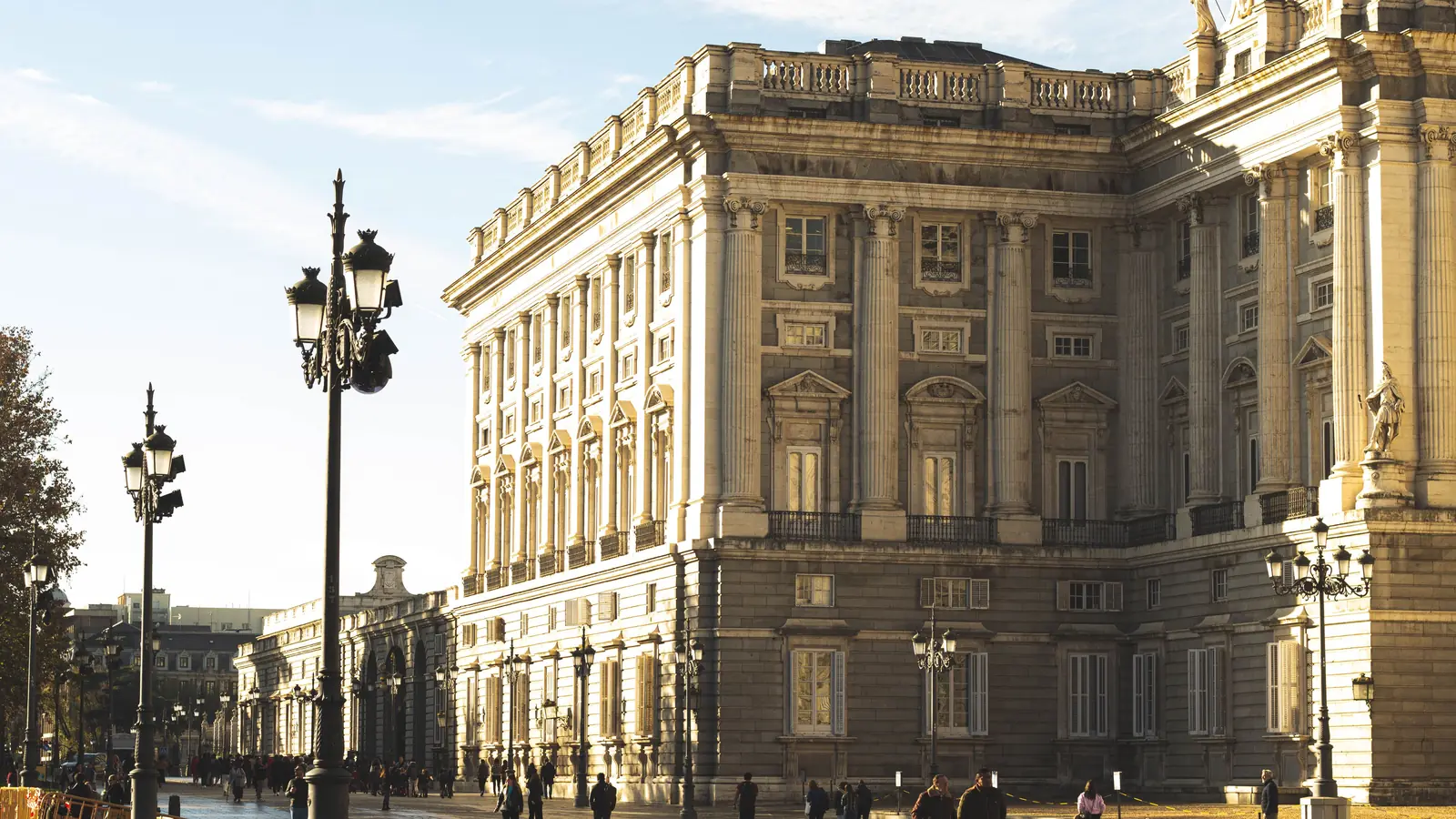
If the old town has a heart, it beats in La Latina. The architecture here doesn’t show off — one house leans on the next — and the neighbourhood makes more sense to your feet than on a map. The squares do the work that monuments do elsewhere: Plaza de la Paja, sloped and car-free, is one of those places where you understand why the city decided to stay. And when the neighbourhood does want to show off, it does it properly: the dome of San Francisco el Grande measures 33 metres across, one of the largest in Europe.
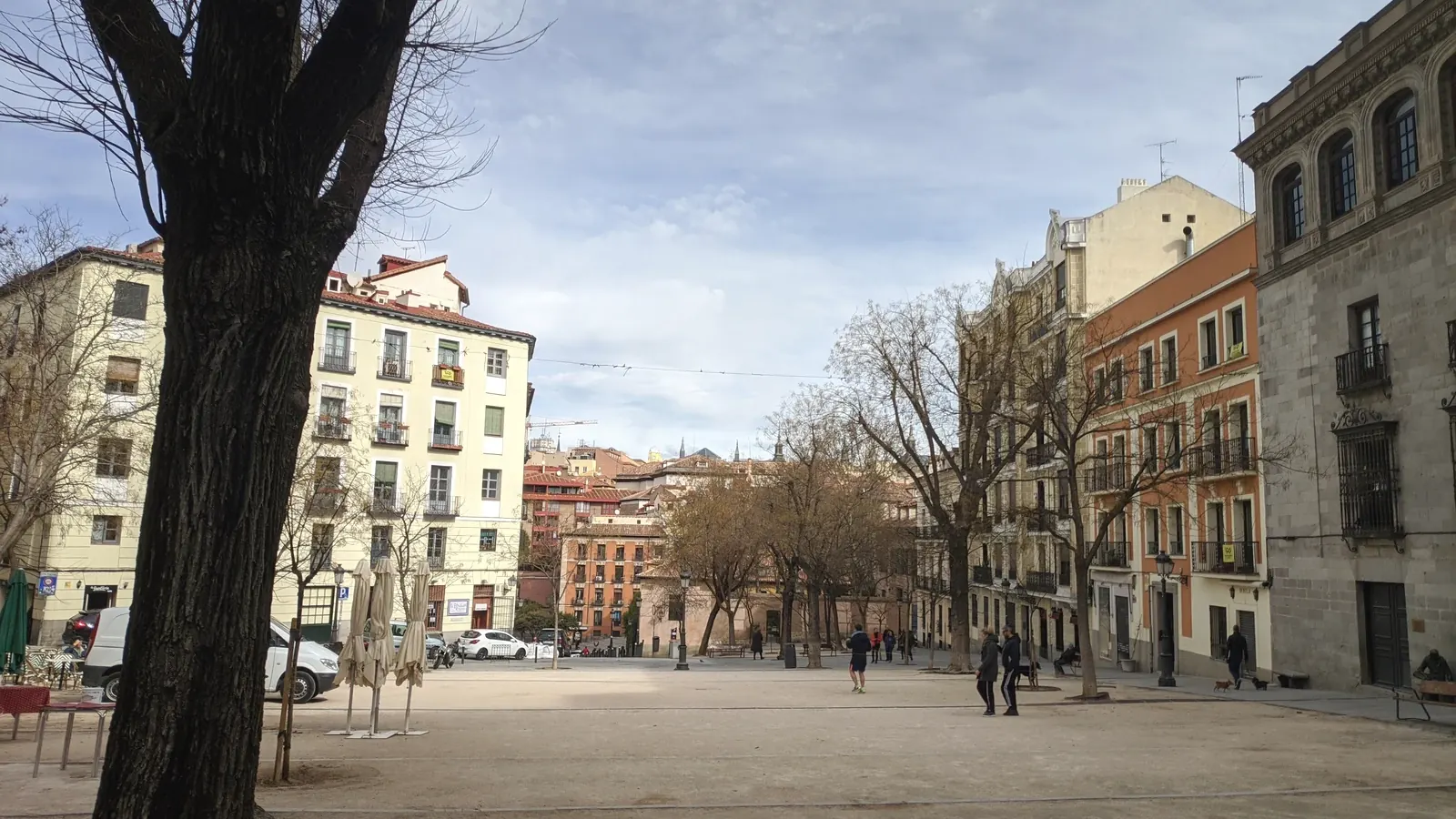
Sunday has its own liturgy: El Rastro in the morning — 9 am to 3 pm, more than a thousand stalls, Spain’s best-known street market — and the vermut afterwards, nobody checking the time. If you are going to come home with something, that is the morning for it — and which Madrid souvenirs are worth the suitcase is a list of its own.
And the warning that honesty demands: the cavas — Cava Baja, Cava Alta — are on that municipal noise list I gave you above. They are the tapas streets par excellence, and you can hear it. Two blocks away, the problem disappears.
- Price and character (€€€): pure old town, plenty of tourist flats.
- Noise and atmosphere: vermut and tapas territory — the peak runs from midday to dinner, Thursday to Sunday above all. The cavas stretch into the small hours; the rest of the neighbourhood switches off earlier.
- Yes, if… it’s your first time and you want to step out of your doorway into Habsburg Madrid; you’re here to eat; your trip is built around a Sunday at El Rastro.
- No, if… you’re a light sleeper and the flat faces the cavas; you’re after everyday neighbourhood life — at the weekend, this neighbourhood works for the visitor.
- Getting to the centre: you won’t need to. You’re inside; the whole old town, on foot.
Lavapiés: the world on a slope
Lavapiés is the most talked-about hill in Madrid and the least understood. A working-class neighbourhood since forever, today it’s the most diverse in the city: the guidebooks speak of 88 nationalities sharing a few blocks. I haven’t counted them, but any evening on the square the figure feels short.
La Tabacalera — the old tobacco factory on Embajadores — sums up the neighbourhood better than any brochure: half state-run art centre, half self-managed community space (that second half has been closed for renovation since 2023; check before you go). On Argumosa, the tree-lined street of terraces, the whole neighbourhood comes out to sit when the sun drops. And at the bottom corner of the neighbourhood, next to Atocha, you have the Reina Sofía.
For eating, one rule only: in Lavapiés you can eat the entire world, and your nose is the best guide.
The neighbourhood’s one physical fact: the slope. From Atocha everything is uphill, and on a bike you’ll feel it. Going down, on the other hand, is a gift.
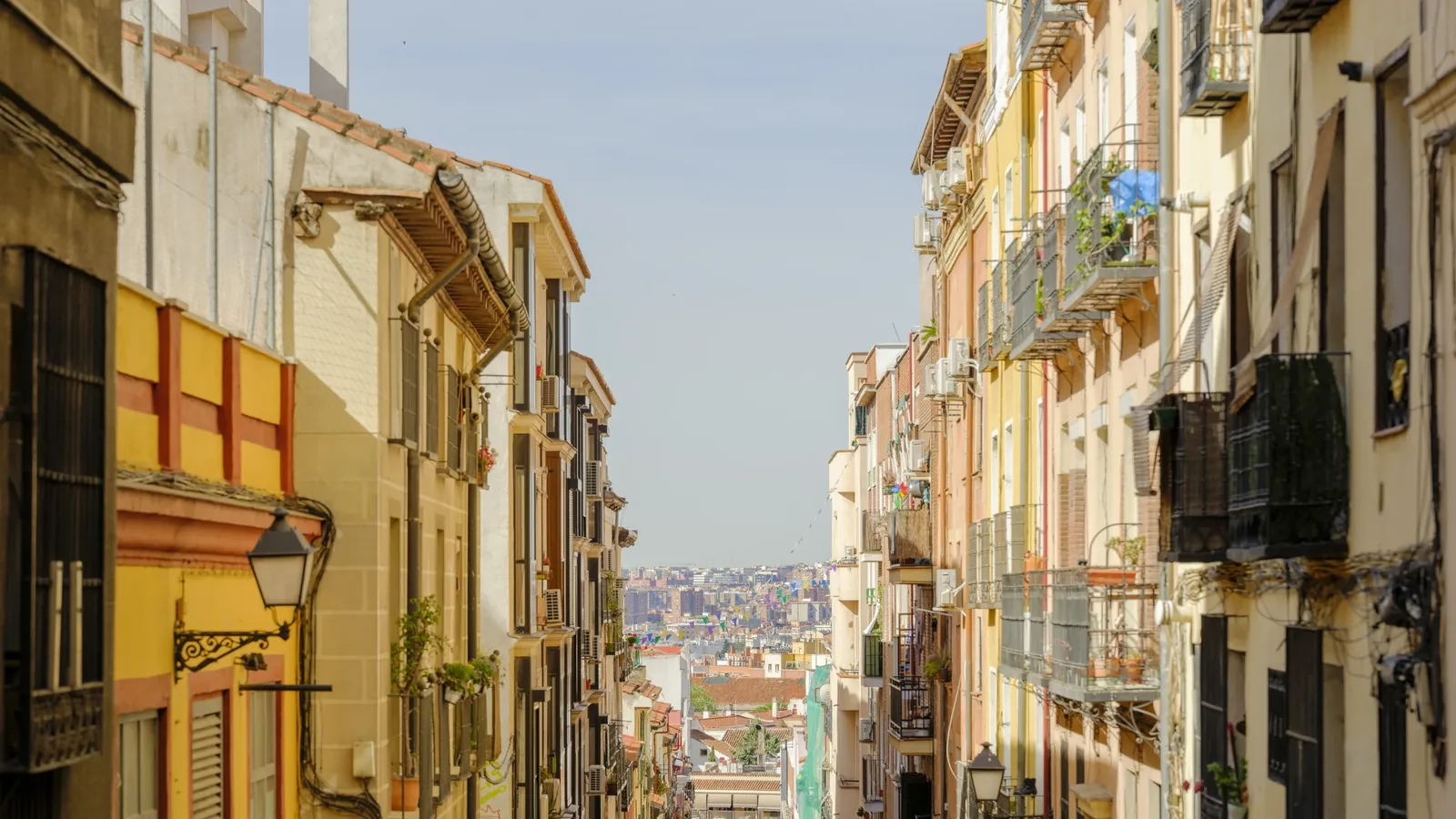
- Price and character (€€): among the most affordable in the centre — the lowest average household income of the eight neighbourhoods in this article. Dense street life, art outside the museums.
- Noise and atmosphere: the noise of squares and terraces, not nightclubs — conversation in the open air until late, more daytime bustle than late-night partying.
- Yes, if… you travel with curiosity, want to eat varied and cheap, and prefer a neighbourhood that is still becoming to one that already was.
- No, if… you’re after postcard Madrid, or intense street life unsettles you more than it energises you.
- Getting to the centre: Atocha and the museum mile on the corner; the rest of the centre, uphill.
Malasaña: the fame and the price of fame
Malasaña carries the name of Manuela Malasaña, one of the heroines of the 2 May 1808 uprising, and Plaza del Dos de Mayo is still the neighbourhood’s living room. The Movida of the eighties passed through here and left both fame and clientele; forty-odd years on, the neighbourhood is still cashing in that fame — and paying for it in decibels and rents.
Fuencarral works as border and axis: pedestrianised between Gran Vía and Hernán Cortés, commercial the whole way. The Mercado de San Ildefonso — three floors of food counters — solves the day you don’t feel like deciding where to eat.
Malasaña is on the noise list — the official one and mine. But apply what I said: the hot zone is a handful of streets, and two blocks in, the neighbourhood is small shops, cafés and neighbours who get up early.
- Price and character (€€€): expensive to rent, not rich — rents here run well ahead of what the locals earn.
- Noise and atmosphere: the longest night in this guide — Thursday to Saturday the neighbourhood doesn’t pull the shutters down. By day, small shops, cafés and a quiet hangover; two blocks from the epicentre, calm.
- Yes, if… you like long nights, vintage shops and bookshops, and want to sleep near everything on a mid-range budget.
- No, if… you get up early with your window on a square, or you’re looking for silence on a Saturday.
- Getting to the centre: everything on foot; Gran Vía on the southern edge.
Chueca: human scale next to Gran Vía
Chueca is Madrid’s LGBTIQ+ reference neighbourhood and home of Pride, yes — but reducing it to that means you’ve never walked it on a Tuesday. It is, above all, human scale one step from Gran Vía: a square that works as a communal courtyard, shops of its own, and a density of places to eat that’s hard to match.
The Mercado de San Antón (Augusto Figueroa 24) has been renovated and keeps its rooftop, and the Museo del Romanticismo, at San Mateo 13, is the most disproportionately good visit in the neighbourhood: almost nobody will mention it to you. Closed on Mondays.
Chueca is on the municipal noise list too. And one note of my own: it’s one of the corners of the centre where a bike suffers least — flat, quiet inside, easy to cross.
- Price and character (€€€€): the most expensive rent per square metre in this article — yes, ahead of Salamanca. Urban life with everything at hand.
- Noise and atmosphere: a live night almost daily — terraces, drinks and an atmosphere that doesn’t distinguish weekdays from weekends; in summer it stretches late, and Pride is the peak of the year. Inside the blocks, more calm than they’ll tell you.
- Yes, if… you want to eat well without planning it, shop differently, and enjoy an open atmosphere where nobody looks twice.
- No, if… silence is your priority, or your budget is tight.
- Getting to the centre: Gran Vía on the corner; the whole centre on foot.
The Plan Castro neighbourhoods: the city drawn at a desk
The next four neighbourhoods share a birth certificate too. By the mid-19th century Madrid had outgrown that old wall, and in 1860 Carlos María de Castro’s expansion plan — the Plan Castro — stretched the city outwards with a perfect grid around the old town, bounded by the ring roads: straight streets because nobody rode a horse any more, wide ones because the tram had to fit; chamfered corners so a carriage could turn without clipping; broad pavements because madam wore a crinoline. A city designed for hygiene, light and the carriage. In old Madrid the king ruled, the Church ruled, lineage ruled; in the ensanche — the expansion — money rules, the engineer rules, the land registry rules.
The plan was one; the fates were four. The east — Salamanca — went to the money. The north — Chamberí — was drawn up as industrial and ended up middle class. The south — Arganzuela — took the railways and the workers. And the strip east of the Retiro — today’s Ibiza neighbourhood — was left on the waiting list and was built up last. That distribution is exactly what you feel today crossing from one neighbourhood to the next: I told you at the start — the architecture tells you the incomes before anyone opens their mouth. Neighbourhood by neighbourhood, then; the last two are also the pair of unnoticed ones I promised at the beginning.
Salamanca: why it’s bourgeois
Salamanca is the ensanche in its luxury edition — the grid designed for the rich. The protagonist, José de Salamanca y Mayol — banker, politician, speculator, brilliant and bankrupt in equal measure — gave the neighbourhood his name and equipped it with things that were science fiction in the Spain of the day: running water, sewerage and a water closet in every home. More than 160 years later it is still the same neighbourhood: expensive, orderly, not very madrileño in the sense the rest of us use the word — but castizo in its own high-born way.
Walking Salamanca is reading a hundred years of bourgeois ambition in stone: façade by façade, from the 19th-century eclecticism of lower Serrano to the neo-Mudéjar of Las Ventas, on the neighbourhood’s edge. The façade is the museum.
What sits behind it lives up to the front: in less than a square kilometre, the Golden Mile — Serrano, Ortega y Gasset, Claudio Coello — carries the most expensive retail rents in the country after Barcelona’s Passeig de Gràcia, with Loewe anchoring the street from a house founded in Madrid in 1846, the oldest fashion house in the LVMH group.
For food, the Mercado de la Paz is still a real market; the neighbourhood’s fine dining gathers around Velázquez, with Jorge Juan as the fashionable street to eat on. And for culture, the Museo Lázaro Galdiano, the National Archaeological Museum (home of the Lady of Elche) and the Fundación Juan March mark the institutional pole, with a circuit of private galleries that erupts every March around the ARCO art fair.
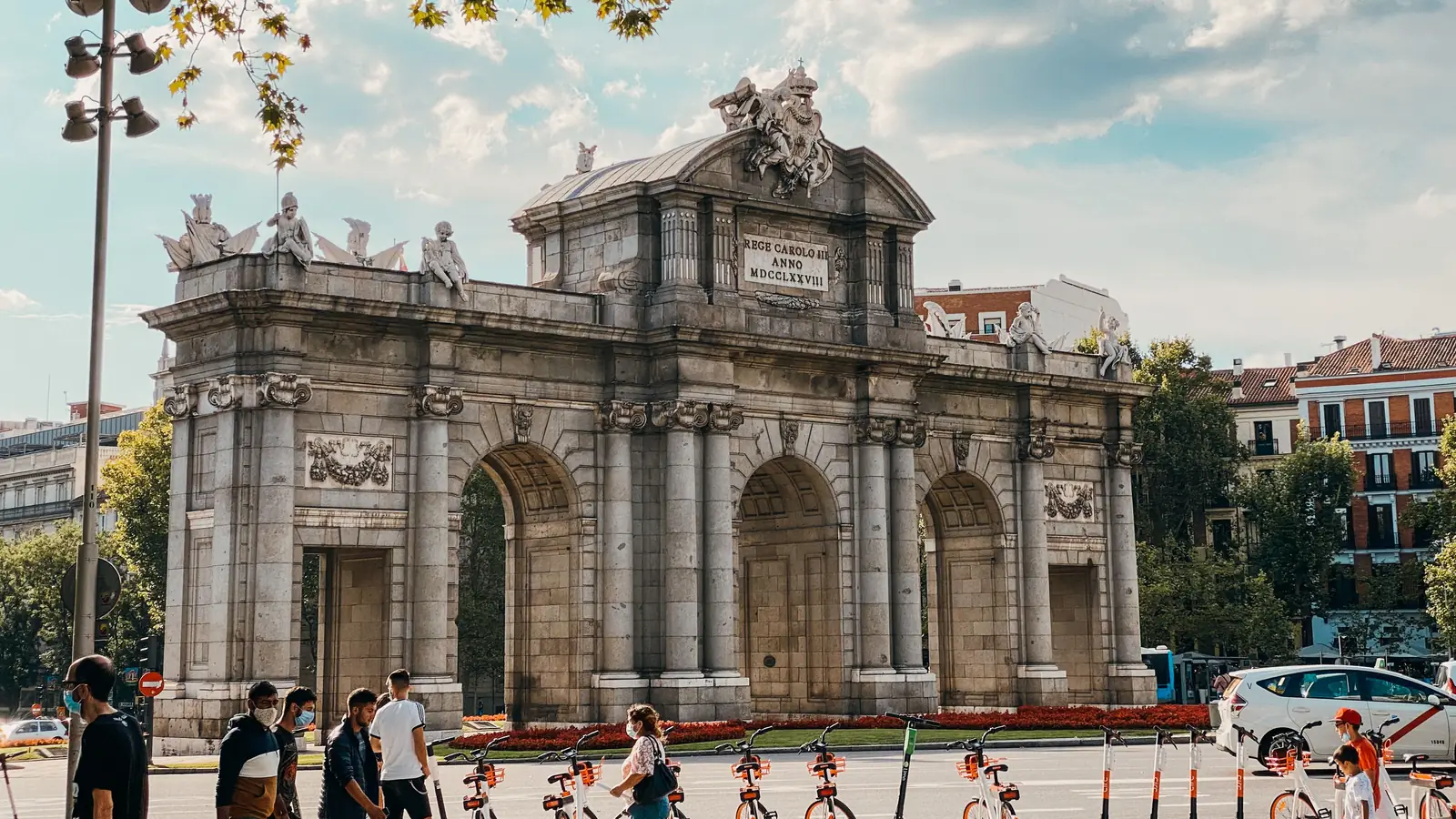
- Price and character (€€€€€): one of the most expensive neighbourhoods in Madrid. High-end tourist flats, high average bill in bars and restaurants.
- Noise and atmosphere: elegant and quiet, with intense daytime life and a short night — it closes between 11 pm and 1 am.
- Yes, if… you put comfort, silence and safety above street life; you’re here for fine dining, luxury shopping (the Golden Mile: Serrano, Ortega y Gasset, Jorge Juan, Claudio Coello) or galleries; a work stay, a family with a generous budget, or you already know the old town and you’re back in Madrid.
- No, if… you want aggressive value for money, old-school neighbourhood life, terraces until two or three in the morning, or to walk out of your doorway straight into Habsburg Madrid.
- Getting to the centre: metro lines 4 and 9 through the heart of the neighbourhood (2, 5 and 6 along its edges), or a 20–25 minute walk to Sol — 15–20 if you start from Puerta de Alcalá.
Chamberí: the Madrid madrileños choose
Chamberí is the move the plan never saw coming: Castro drew it up as industrial, and it became the residential neighbourhood of the middle class. Today it answers a question almost no visitor asks: where does the madrileño who loves Madrid actually live? It’s ensanche, like Salamanca, but with no golden mile: here the luxury is Plaza de Olavide — an octagon renovated in 2024, terraces at all hours, zero monuments — and the Mercado de Vallehermoso, where the daily shop and the lunch counter get along without fuss.
Two stops worth the stroll: Andén 0, Chamberí’s ghost metro station — free guided visit, booking required, Friday afternoons and weekends — and Ponzano, the tapas street madrileños defend as their own territory.
- Price and character (€€€€): the second-highest household income in this article, without Salamanca’s shop window. Residential, orderly, with the best-distributed food scene in the city.
- Noise and atmosphere: counters and long lunches — the tapas get intense on Ponzano and around Olavide, and not much further; the rest is residential silence.
- Yes, if… it’s not your first Madrid, you’re staying a while, or you prefer the city’s routine to its postcard.
- No, if… it’s your first time and you want monuments at your door — from here everything is a stroll away, but nothing is at the door.
- Getting to the centre: down Fuencarral to Malasaña; the centre, a 15–25 minute walk depending on where you start.
Ibiza: the neighbourhood with the Retiro for a front garden
First of the two unnoticed ones. The Ibiza neighbourhood is the part of the ensanche that stayed on the waiting list: in Castro’s plans this strip was drawn as woodland extending the Retiro, it stayed rural for decades and was built up last. Today it’s what lies east of the Retiro — and almost nobody looks east of the Retiro. The city’s tourism office describes it as one of the areas with the highest concentration of taverns and restaurants in Madrid, and in 2025 Time Out called Retiro perhaps the city’s most varied neighbourhood for tapas. The tourists, meanwhile, stay on the other shore of the park.
The life is on the Doctor Castelo–Menorca axis and around the market on Calle Ibiza — a neighbourhood market with a municipal cultural centre inside, which is the fastest way to understand what kind of neighbourhood this is. The food scene here is tablecloths and tapas, not late-night drinks.
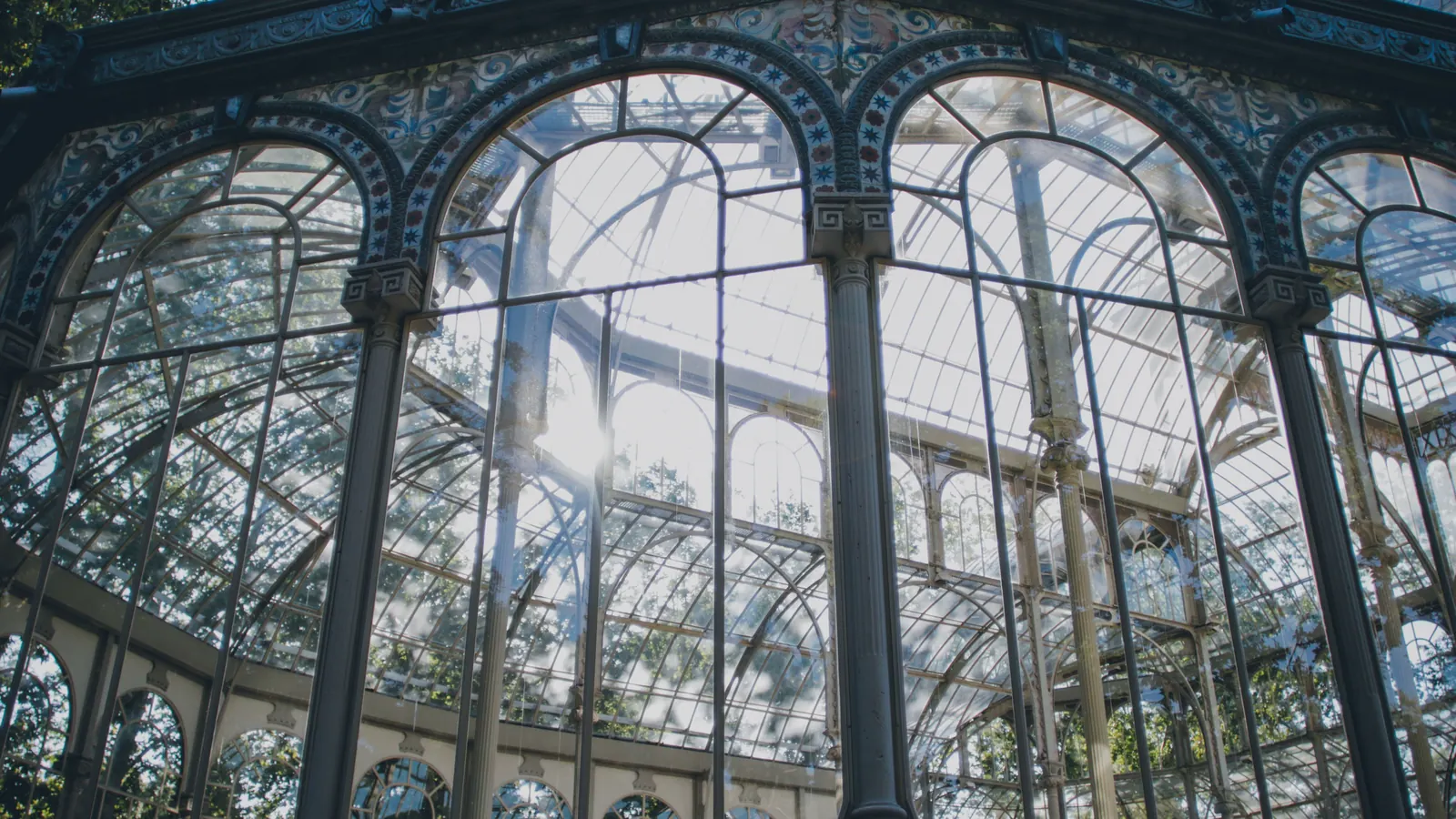
- Price and character (€€€€): the madrileños have already discovered it and the menus show it. Elegant without a uniform, genuinely residential.
- Noise and atmosphere: tablecloths and tapas, no late-night bar scene — dinner, a long sobremesa, and home. It appears on no noise list: you sleep.
- Yes, if… you want to sleep well, eat better and have the Retiro as your front garden; you’re travelling with children.
- No, if… you need monuments at the door (they’re on the other side of the park) or you want a classic hotel — here the holiday flat rules.
- Getting to the centre: metro Ibiza (line 9) at the door and Príncipe de Vergara (2 and 9) close by — line 2 drops you at Sol. On foot you cross the Retiro: the prettiest commute in this article.
La Chopera–Delicias: the secret travels along the river
And the second. La Chopera and Delicias are the south the plan handed to the railways and the workers — the Delicias station arrived here in 1880, and the workers’ housing colonies with it. A century and a half later, alongside the Manzanares, they are my bet for the reader who has got this far thinking about pedalling: the old municipal slaughterhouse is now Matadero Madrid, a cultural centre of neo-Mudéjar pavilions with free entry, and the river that used to be a sewer is now the best bike lane in the city — the Madrid Río corridor, flat and car-free, that carries you to the centre along the bank.
Neighbourhood life: the Guillermo de Osma municipal market for the shopping, Tierno Galván park — with the Planetarium — for the views, and one weekend a month the Mercado de Motores, between the platforms of the Railway Museum.
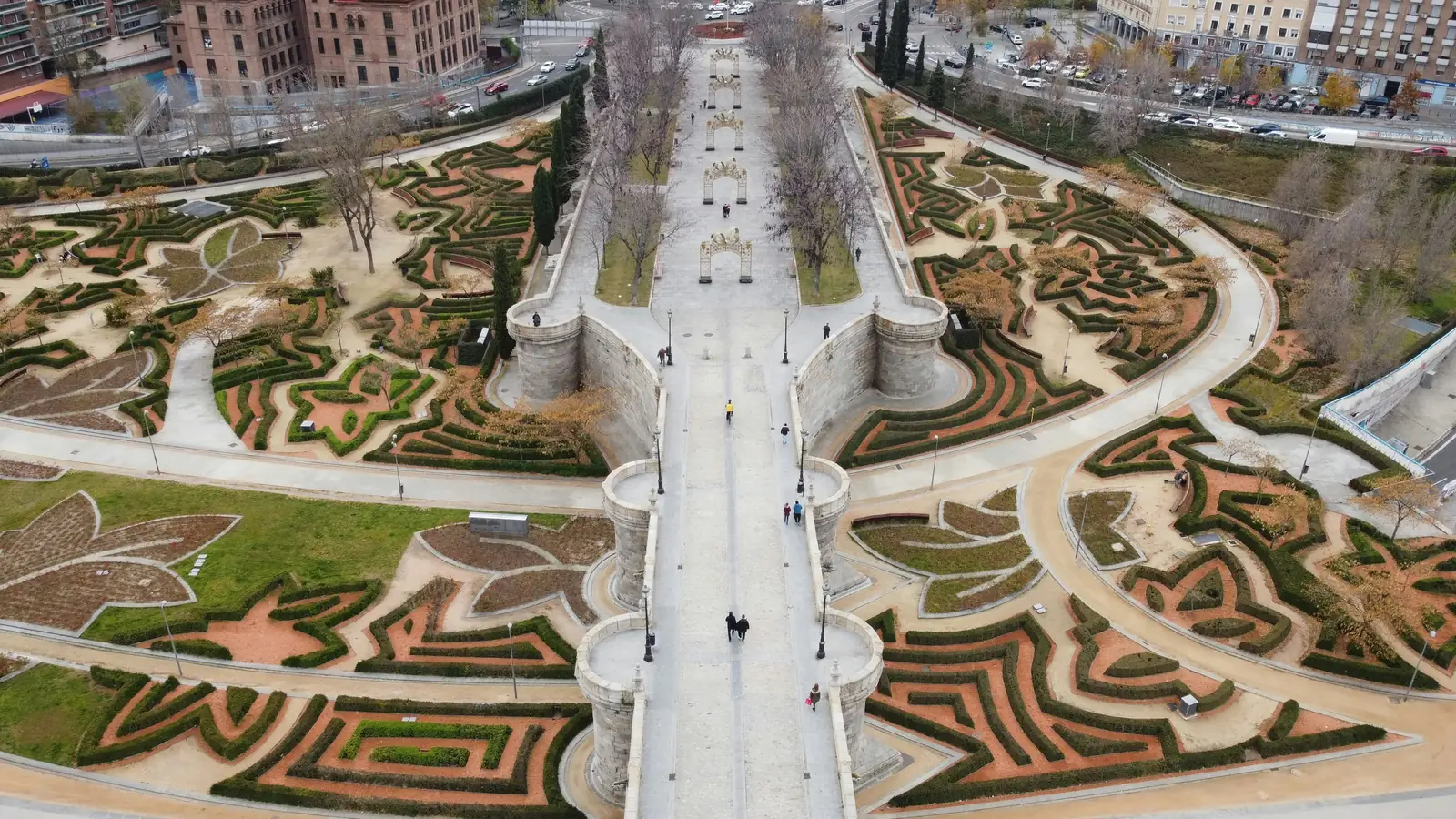
What there isn’t: a postcard. The heritage here is industrial and working-class housing, and the nights are so quiet that anyone after drinks will have to head up to the centre. To me that’s an argument in its favour; you’ll know best. And hurry, relatively speaking: the rents are warning that it’s stopping being a secret.
- Price and character (€€): the cheapest square metre in this article, for sale and for rent. Residential, with the river as its backbone.
- Noise and atmosphere: the most serious silence in this guide — residential-neighbourhood nights; the nightlife, if you want it, is a stroll away in the centre.
- Yes, if… you get around by bike, you’re more interested in the life than the photo, and real silence at night sounds like luxury.
- No, if… you want the old town at your door, or a night scene at street level.
- Getting to the centre: metro Legazpi (lines 3 and 6) at Matadero’s door; by bike, Madrid Río all the way in.
The neighbourhoods by bike: a morning route
A suggestion for a Saturday morning — adjust it on the ground; the streets are in charge:
- Start in La Latina (Plaza de la Paja) while the old town is still half asleep.
- Climb to Malasaña along Calle del Pez; coffee on Plaza del Dos de Mayo.
- Cross into Chueca; stop at the Mercado de San Antón.
- Carry on north to Plaza de Olavide, in Chamberí. Vermut or lunch, and that’s the route.
It’s around 5 km, with no serious climbs — unless you add Lavapiés: that hill is real. Some context that helps: in Spain, the urban speed limit on single-lane streets has been 30 km/h since 2021 — and in central Madrid that’s nearly all of them — and BiciMAD, the public electric bike system, reached 653 stations and just over 8,000 bikes across all 21 districts in spring 2026. Bike lanes change often: check their state before your trip. And if you’re sleeping in La Chopera, your motorway is a different one: Madrid Río, along the bank, flat all the way to the centre.
Frequently asked questions
Where should I stay in Madrid for the first time?
If you want the old town at your door, La Latina or the area around Sol — accepting the deal: central and lively is paid for in decibels (see the interior-courtyard trick above). If you’d rather sleep in silence and walk fifteen minutes, Chamberí or the Ibiza neighbourhood. Once the bed is sorted, the next question is what to do with your days — I’ve written up planning three days in Madrid the way I’d tell a friend.
Which neighbourhood fits you depends on how you plan to spend the days. If that part is still open, settle it first with what to do in Madrid, then come back here.
What’s the best neighborhood to stay in Madrid?
There isn’t one, and that’s the honest answer — but there is a best one for you. First visit and you want the city at the door: La Latina. Nightlife within walking distance: Malasaña or Chueca. Quiet, with the old town fifteen minutes away: Chamberí or Ibiza. Travelling with family: Ibiza or Salamanca, for the pavements and the parks. Watching the budget: La Chopera–Delicias, by the river.
Is it safe to cycle in central Madrid?
Safer than it looks from the outside. Since 2021 the limit on single-lane streets is 30 km/h — which covers nearly all of the centre — and the public electric bikes have more than 650 stations across the 21 districts. In the old town, favour quiet streets and respect the cobbles when it rains.
Which neighbourhood is the most authentic?
“Authentic” is my least favourite word in this trade, so let me translate it. Everyday life without a costume? Chamberí, Ibiza or La Chopera. Centuries and taverns with documented history? La Latina and Lavapiés. The city’s present tense? Lavapiés again. They are all real Madrid; none of them will put it on a sign for you.
Where should families stay in Madrid?
Salamanca and Ibiza: quiet streets, the Retiro next door and short nights. Chamberí works just as well on a more contained budget. The four central neighbourhoods work too — with deep-sleeping children, or an interior courtyard.
What if I’m a light sleeper?
Salamanca, Ibiza, Chamberí or La Chopera. And inside any neighbourhood, the rule as always: look at what the window faces before you look at the neighbourhood. An interior courtyard in Malasaña beats a balcony over Cava Baja.
There is no best neighbourhood (and that’s the good news)
Keep the arithmetic from the beginning: fifteen minutes on foot between one Madrid and the next; five by bike. Choosing where to stay in Madrid isn’t an exam — it’s deciding which city you want to wake up in, knowing all the others are still next door. Whichever way you get it wrong, the right answer is three streets away.
And if on your first day you’d rather have someone put the neighbourhoods in order as you ride — slowly, never more than eight of us — that’s what I pedal every morning and every afternoon on the Hidden Madrid Bike Tour.
Photos: Dinamo Bike Tours and third-party photographers, used under free licence.